Introduction: India’s Semiconductor Industry Is Entering a New Growth Era
India is positioning itself as an important player in the global semiconductor industry. With increasing investments in chip manufacturing, government support, electronics production and supply-chain diversification, the country is moving beyond being primarily an importer of semiconductor components towards developing its own semiconductor manufacturing ecosystem.
Semiconductors are the backbone of modern technology. They are used in smartphones, electric vehicles, automobiles, computers, telecommunications, artificial intelligence, defence equipment and industrial automation.
However, semiconductor manufacturing is not just about silicon wafers and sophisticated machinery. It also requires a highly specialised supply chain of ultra-high-purity chemicals, electronic-grade solvents, specialty gases, acids, photoresists and advanced materials.
This creates a significant opportunity for India’s chemical and specialty chemical industry.
For chemical manufacturers, importers, distributors and traders, the semiconductor expansion could open up a new high-value market over the coming years.
1. Why Is Semiconductor Manufacturing Growing in India?
Several factors are driving India’s semiconductor ambitions:
- Government initiatives: The India Semiconductor Mission (ISM) supports semiconductor fabrication, display manufacturing and semiconductor packaging.
- Electronics manufacturing growth: Increasing demand for smartphones, computers, consumer electronics and automotive electronics.
- Electric vehicle expansion: EVs require advanced power semiconductors, sensors and electronic control systems.
- AI and data centres: Growing demand for high-performance processors, memory chips and supporting electronics.
- Global supply-chain diversification: Companies are looking to diversify semiconductor manufacturing beyond traditional manufacturing hubs.
India’s semiconductor opportunity is therefore not limited to chip manufacturing. It extends to chemicals, gases, materials, equipment, packaging and industrial infrastructure.
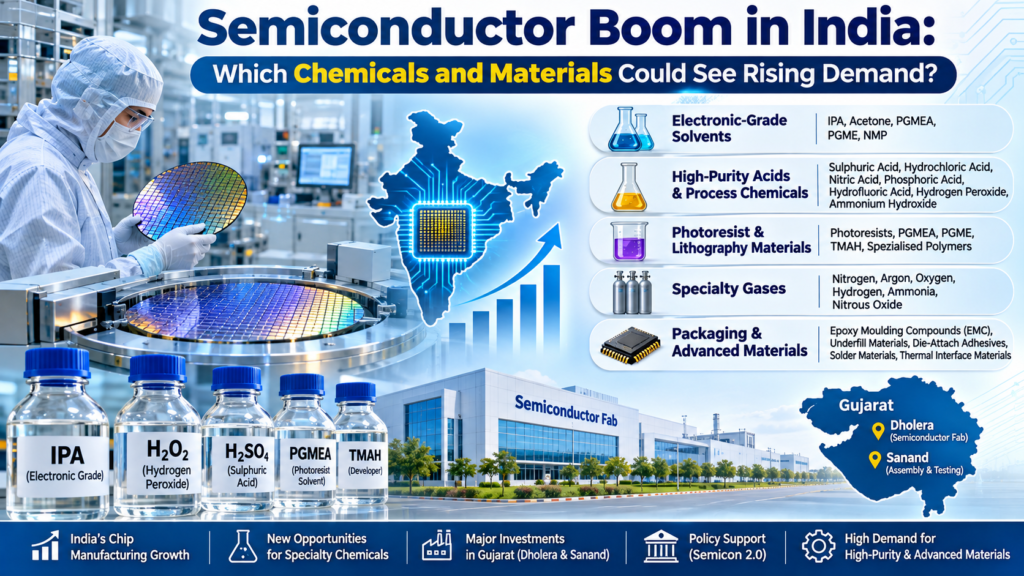
2. Which Chemicals and Materials Could See Higher Demand?
Semiconductor manufacturing requires chemicals with extremely high purity levels. Even microscopic contamination can affect chip performance, production yield and manufacturing quality.
The following categories could offer opportunities for chemical manufacturers and suppliers.
A. Electronic-Grade Solvents
Semiconductor Chemicals: Sulfuric Acid, Nitric Acid & NH₄OH
Solvents are used for wafer cleaning, surface preparation, photoresist processing and removal of organic contaminants.
| Chemical | CAS Number | Potential application |
|---|---|---|
| Isopropyl Alcohol (IPA) | 67-63-0 | Wafer cleaning and drying |
| Acetone | 67-64-1 | Cleaning and degreasing |
| PGMEA | 108-65-6 | Photoresist solvent |
| PGME | 107-98-2 | Lithography formulations |
| Ethanol | 64-17-5 | Cleaning and processing |
| N-Methyl-2-Pyrrolidone (NMP) | 872-50-4 | Selected stripping and cleaning applications |
Business opportunity: Electronic-grade IPA, PGMEA and PGME could become particularly interesting specialty-solvent categories as semiconductor manufacturing capacity expands.
An important distinction: conventional industrial or pharmaceutical-grade solvents cannot automatically be sold as semiconductor-grade materials. Semiconductor applications require stringent specifications for metals, particles, moisture and other contaminants.
B. High-Purity Acids and Process Chemicals
Air Filtration Solutions for the Semiconductor Industry — Clean-Link
Acids and process chemicals play an essential role in wafer cleaning, etching and surface treatment.
| Chemical | CAS Number | Potential application |
|---|---|---|
| Sulphuric Acid (H₂SO₄) | 7664-93-9 | Wafer cleaning |
| Hydrochloric Acid (HCl) | 7647-01-0 | Surface cleaning |
| Nitric Acid (HNO₃) | 7697-37-2 | Metal etching and processing |
| Phosphoric Acid (H₃PO₄) | 7664-38-2 | Selective etching |
| Hydrofluoric Acid (HF) | 7664-39-3 | Silicon oxide etching |
| Hydrogen Peroxide (H₂O₂) | 7722-84-1 | Wafer cleaning and oxidation |
| Ammonium Hydroxide (NH₄OH) | 1336-21-6 | Wafer cleaning formulations |
Business opportunity: High-purity sulphuric acid, hydrogen peroxide, ammonia water and hydrochloric acid may create opportunities for specialised chemical manufacturers and purification companies.
These chemicals require dedicated semiconductor-grade production, storage, handling and quality-control systems.
C. Photoresist and Lithography Materials
Photolithography is one of the most critical stages of semiconductor manufacturing. It transfers extremely small circuit patterns onto silicon wafers.
Important materials include:
- Photoresist chemicals
- PGMEA and PGME solvents
- Photoresist developers such as TMAH
- Specialised polymers and resins
- High-purity additives and formulation ingredients
| Material | CAS Number | Application |
|---|---|---|
| Tetramethylammonium Hydroxide (TMAH) | 75-59-2 | Photoresist development |
| PGMEA | 108-65-6 | Photoresist solvent |
| PGME | 107-98-2 | Lithography solvent |
| Electronic-grade polymers | Grade dependent | Photoresist formulations |
This segment is particularly attractive because it involves specialised formulations, stringent quality requirements and higher technical entry barriers.
D. Specialty Gases
Specialty Gas Delivery Systems in Semiconductor Manufacturing
Semiconductor fabs require high-purity gases for deposition, etching, cleaning and controlled manufacturing environments.
| Gas | CAS Number | Application |
|---|---|---|
| Nitrogen | 7727-37-9 | Purging and inert atmosphere |
| Argon | 7440-37-1 | Plasma processing |
| Oxygen | 7782-44-7 | Oxidation and plasma processing |
| Hydrogen | 1333-74-0 | Reduction and processing |
| Ammonia | 7664-41-7 | Deposition processes |
| Nitrous Oxide | 10024-97-2 | Oxide deposition |
Specialty gases require high-purity production, specialised cylinders, gas cabinets, monitoring systems and safe distribution infrastructure.
E. Semiconductor Packaging and Advanced Materials
Molding Machine | Semiconductor Packaging Equipment – GEEKVALUE
After wafer fabrication, chips undergo assembly, packaging and testing. This stage also requires a specialised range of chemicals and materials.
Potentially important materials include:
- Epoxy Moulding Compounds (EMC)
- Semiconductor-grade epoxy resins
- Underfill materials
- Die-attach adhesives
- Solder materials
- Copper plating chemicals
- High-performance encapsulation materials
- Thermal interface materials
With the expansion of ATMP and OSAT facilities in India, demand for advanced packaging materials could become another important growth area.
3. Gujarat: A Major Opportunity for Chemical Suppliers
PM Modi to inaugurate Micron’s facility in Gujarat which houses world-class cleanroom
Narendra Modi (@narendramodi) on X
Top Industrial Projects in Dholera SIR – We9 Properties
8
Gujarat could become one of India’s most important semiconductor manufacturing destinations.
Two major locations deserve particular attention:
1. Dholera – Semiconductor Fabrication
Tata Electronics is developing a semiconductor fabrication facility in Dholera in partnership with Taiwan’s PSMC. The project has an announced investment of approximately ₹91,526 crore and a planned capacity of 50,000 wafer starts per month.
2. Sanand – Semiconductor Assembly and Testing
Sanand is emerging as a major semiconductor assembly, testing and packaging hub.
Key developments include:
- Micron’s semiconductor assembly and test facility.
- Kaynes Semicon’s semiconductor manufacturing project.
- CG Power’s semiconductor assembly and testing operations.
These developments could create opportunities for chemical suppliers, specialty material manufacturers, logistics companies and industrial service providers. Press Information Bureau+2
For Ahmedabad-based chemical traders and manufacturers, the developing Dholera–Sanand industrial ecosystem deserves close attention.
4. India’s Import Dependency Creates Opportunities for Domestic Manufacturers
India’s semiconductor supply chain still depends significantly on imported materials, especially specialised electronic-grade chemicals, gases, substrates and manufacturing equipment.
A recent industry report highlighted that more than 70% of electronic-grade chemicals are imported, creating opportunities for domestic manufacturers to develop local alternatives. NDTV Profit+1
This presents three major business opportunities:
- Import and distribution: Supplying qualified semiconductor-grade chemicals from established international manufacturers.
- Domestic manufacturing: Investing in high-purity chemical production and purification technology.
- Specialty chemical development: Developing customised formulations and advanced materials in collaboration with semiconductor manufacturers.
The opportunity is not simply to sell more conventional chemicals. It is to move towards higher-purity, higher-value products with strict quality assurance.
5. Recent Industry Developments: Chemical Companies Are Positioning Themselves
The opportunity is already attracting chemical manufacturers and international technology companies.
Some notable developments include:
- Tata Electronics and Sumitomo Chemical: Their September 2026 collaboration explores semiconductor materials for the upcoming Dholera facility, including photoresists, hydrogen peroxide, IPA, ammonia water and sulphuric acid. ChemAnalyst
- Acutaas Chemicals: Has entered the semiconductor chemicals segment through a collaboration with a Korean company. NDTV Profit
- Tatva Chintan Pharma Chem: Has been developing semiconductor-related specialty chemicals. NDTV Profit
- Aether Industries: Has announced plans to develop advanced materials for semiconductor applications. NDTV Profit
- Anupam Rasayan: Has strengthened its specialty chemicals capabilities through its acquisition of Jayhawk Fine Chemicals. NDTV Profit
These developments indicate that India’s specialty chemical industry is beginning to explore opportunities beyond traditional pharmaceutical, agrochemical and industrial applications.
6. What Should Chemical Traders and Manufacturers Focus On?
For chemical trading companies, the semiconductor industry offers an opportunity to develop a specialised business vertical.
The following products deserve attention:
| Priority | Product | Business opportunity |
|---|---|---|
| High | Electronic-grade IPA | Cleaning and wafer processing |
| High | Electronic-grade Hydrogen Peroxide | Wafer cleaning |
| High | High-purity Sulphuric Acid | Wet processing |
| High | PGMEA | Lithography |
| High | PGME | Lithography and cleaning |
| Medium | Electronic-grade Acetone | Cleaning applications |
| Medium | Ammonia Water | Wafer cleaning |
| Medium | Electronic-grade HCl | Wet processing |
| Specialised | Photoresist | Lithography |
| Specialised | TMAH | Photoresist development |
| Specialised | Epoxy Moulding Compounds | Chip packaging |
A practical strategy for chemical trading companies:
- Identify international manufacturers of electronic-grade chemicals.
- Develop relationships with Japanese, Korean, Taiwanese and European suppliers.
- Identify Indian semiconductor fabs and packaging companies.
- Understand their approved vendor registration procedures.
- Obtain technical specifications, COA, SDS and impurity profiles.
- Explore distribution partnerships with qualified manufacturers.
Remember that a standard chemical COA is not sufficient for semiconductor qualification. Customers may require trace-metal analysis, particle counts, purity validation, packaging qualification and extensive supplier audits.
7. Government Support: India Semiconductor Mission 2.0
India’s semiconductor development is receiving additional policy support.
In July 2026, the Union Cabinet approved Semicon 2.0 with a total budget outlay of ₹1,27,500 crore.
The programme specifically includes support for:
- Semiconductor manufacturing equipment.
- Specialised materials and chemicals.
- Semiconductor gases.
- Domestic supply-chain development.
- Advanced semiconductor manufacturing.
- Semiconductor research and design.
The initiative aims to build a stronger domestic ecosystem rather than depending entirely on imported manufacturing materials. Prime Minister of India+1
This is particularly relevant for India’s specialty chemical manufacturers looking to enter technically demanding industries.
8. Future Outlook: What Could Happen Between 2026 and 2030?
The next four years could be important for India’s semiconductor and specialty chemical industries.
India Semiconductor Opportunity Roadmap
- 2026 – Ecosystem developmentSemiconductor projects move towards production, while suppliers begin qualification and sourcing activities.
- 2027 – Supply-chain expansionGreater focus on local sourcing, packaging materials, specialty gases and electronic-grade chemicals.
- 2028 – Manufacturing scale-upMore opportunities may emerge as fabrication and associated manufacturing facilities progress towards commissioning.
- 2029–2030 – Localisation opportunitiesPotential expansion of domestic manufacturing of high-purity chemicals, advanced materials and semiconductor consumables.
Indicative industry outlook, not a confirmed commissioning schedule for every project.
The long-term opportunity will depend on actual fab commissioning, production volumes, technology requirements and successful qualification of domestic suppliers.
Conclusion: A New Growth Opportunity for India’s Chemical Industry
India’s semiconductor boom is not just a technology story. It could also become a major opportunity for the specialty chemical industry.
From electronic-grade IPA and PGMEA to high-purity hydrogen peroxide, sulphuric acid, ammonia water, photoresists and advanced packaging materials, semiconductor manufacturing requires a wide range of specialised chemical inputs.
For India’s chemical manufacturers, importers and distributors, this is an opportunity to move up the value chain.
The future of chemical trading will not only depend on how much chemical a company can supply, but also on the purity, consistency, technical specifications and reliability it can deliver.
Companies that start developing semiconductor-grade sourcing capabilities and technical partnerships today may be better positioned to participate in India’s emerging semiconductor supply chain.