
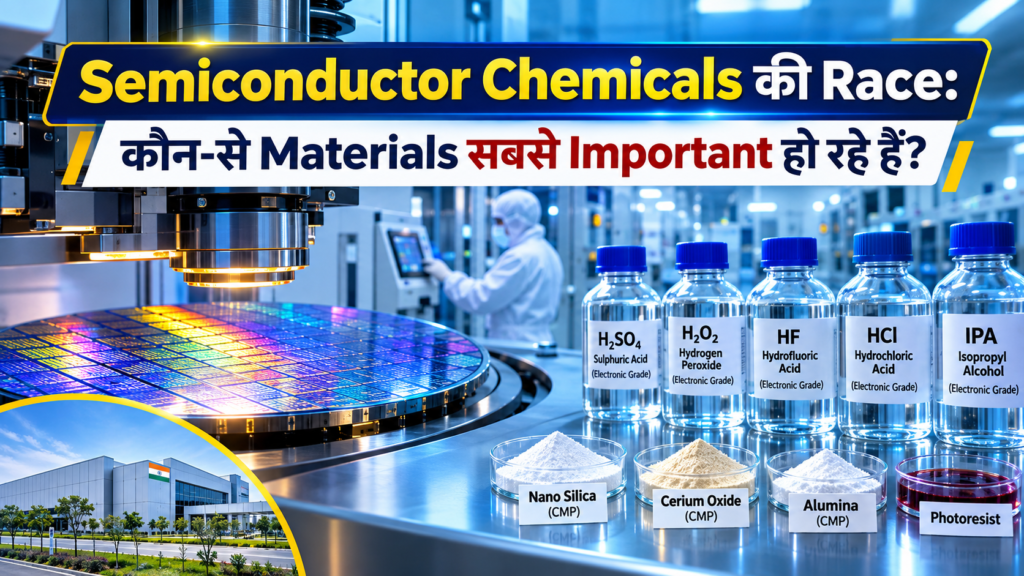
Introduction: India’s Semiconductor Ambition Is Creating a New Chemical Opportunity
India is entering an important phase in its journey towards becoming a global semiconductor manufacturing hub. With growing investments in semiconductor fabrication plants, display manufacturing, chip assembly, testing and packaging facilities, the country is gradually building a domestic semiconductor ecosystem.
For years, semiconductor manufacturing has been concentrated in countries such as Taiwan, South Korea, Japan, China and the United States. However, changing global supply chains, geopolitical developments and the growing demand for electronics have encouraged India to accelerate its semiconductor ambitions.
While much of the attention is focused on semiconductor companies, government incentives, fabrication plants and technology partnerships, another industry is quietly becoming increasingly important: the specialty chemicals and advanced materials industry.
Semiconductor manufacturing requires hundreds of highly specialized materials. These include ultra-high-purity acids, solvents, photoresists, electronic gases, etching chemicals, cleaning agents, polishing slurries and advanced packaging materials.
Even extremely small levels of contamination can affect chip performance, production yield and reliability.
This creates a significant opportunity for India’s chemical manufacturers, importers, distributors and specialty chemical suppliers.
For the Indian chemical industry, the semiconductor revolution is not just about silicon wafers. It is also about the chemicals required to manufacture, process, clean, polish and protect them.
1. Why semiconductor manufacturing needs specialty chemicals
A semiconductor chip is manufactured through hundreds of highly controlled processing steps. Chemicals are used repeatedly to clean, coat, develop, etch, polish and prepare silicon wafers.
The semiconductor manufacturing process includes:
- Silicon wafer preparation
- Wafer cleaning
- Photoresist coating
- Photolithography
- Etching
- Doping and deposition
- Chemical Mechanical Planarization (CMP)
- Final cleaning
- Wafer inspection
- Assembly, packaging and testing
Each step requires chemicals with specific purity, particle-size, moisture and contamination limits.
For example, ordinary industrial-grade chemicals cannot simply be substituted for semiconductor-grade chemicals. Semiconductor production may require electronic-grade materials with exceptionally low metallic impurities, controlled particles and trace contamination.
According to semiconductor process-chemical documentation published by Fujifilm, cleaning, drying and etching chemicals are used repeatedly throughout wafer manufacturing. Fujifilm+1
2. Top semiconductor chemicals gaining importance in India
The following materials are among the most important chemical categories in semiconductor manufacturing.
FUJIFILM Electronic Chemicals 064103 Sulfuric Acid 96%, Megabit Grade, 4×1-Gallo
1. Sulphuric Acid (H₂SO₄)
- CAS No.: 7664-93-9
- Application: Wafer cleaning and removal of organic contaminants.
- Used in: Semiconductor wet-processing operations.
- Procurement opportunity: Ultra-high-purity electronic-grade sulphuric acid.High-priority chemical
2. Hydrogen Peroxide (H₂O₂)
- CAS No.: 7722-84-1
- Application: Wafer cleaning and oxidation-based removal of organic residues.
- Used in: RCA cleaning and other semiconductor cleaning formulations.
- Procurement opportunity: High-purity electronic-grade hydrogen peroxide.High-priority chemical
Top Electronic Hydrofluoric Acid Producers Worldwide (2026)
3. Hydrofluoric Acid (HF)
- CAS No.: 7664-39-3
- Application: Removal of silicon dioxide layers and native oxide.
- Used in: Wafer etching and surface preparation.
- Procurement opportunity: Electronic-grade HF and buffered oxide etchants (BOE).Critical process chemical
Hydrochloric Acid 37% Solution, Semiconductor Grade | Lab Alley
4. Hydrochloric Acid (HCl)
- CAS No.: 7647-01-0
- Application: Removal of metallic contamination.
- Used in: Wafer cleaning formulations.
- Procurement opportunity: Ultra-pure electronic-grade HCl.
5. Nitric Acid (HNO₃)
- CAS No.: 7697-37-2
- Application: Oxidizing and cleaning operations, including selected metal etching processes.
- Used in: Semiconductor wet processing.
- Procurement opportunity: High-purity nitric acid.
6. Phosphoric Acid (H₃PO₄)
- CAS No.: 7664-38-2
- Application: Selective etching of silicon nitride in certain processes.
- Used in: Wafer fabrication.
- Procurement opportunity: High-purity electronic-grade phosphoric acid.
Isopropyl Alcohol for Electronics: 70% vs 91% vs 99%
7. Isopropyl Alcohol (IPA)
- CAS No.: 67-63-0
- Application: Wafer rinsing, drying and cleaning.
- Used in: Semiconductor fabrication and equipment cleaning.
- Procurement opportunity: Electronic-grade IPA with low moisture and low metallic impurities.
8. Ammonium Hydroxide (NH₄OH)
- CAS No.: 1336-21-6
- Application: Removal of particles and organic contamination.
- Used in: SC-1 wafer cleaning formulations.
- Procurement opportunity: Electronic-grade ammonia solution.
These eight chemicals form an important part of the wet-processing chemical portfolio. Actual consumption and specifications depend on the fab’s process technology. Fujifilm+1
3. Advanced semiconductor materials beyond conventional acids and solvents
The semiconductor chemical opportunity extends far beyond conventional industrial chemicals. Several advanced materials are essential for manufacturing modern chips.
Extreme ultraviolet lithography | Nature Reviews Methods Primers
9. Photoresist Chemicals
Photoresists are light-sensitive materials used to transfer microscopic circuit patterns onto silicon wafers.
Important materials:
- Positive photoresist
- Negative photoresist
- Chemically amplified photoresist
- EUV photoresist
Opportunity: Advanced photoresist formulation and specialty raw-material supply.
10. Photoresist Developers
Used to remove selected portions of photoresist after exposure.
Important chemicals:
- TMAH (Tetramethylammonium Hydroxide), CAS 75-59-2
- Potassium Hydroxide, CAS 1310-58-3
- Sodium Hydroxide, CAS 1310-73-2
Opportunity: High-purity developers and formulated solutions.
동진쎄미켐, 미국 공장 설립 투자금 682억 확보 – 전자신문
11. Electronic-Grade Solvents
Used for cleaning, photoresist processing, stripping and equipment maintenance.
Important solvents:
- Acetone – CAS 67-64-1
- Methanol – CAS 67-56-1
- Ethanol – CAS 64-17-5
- N-Methyl-2-pyrrolidone (NMP) – CAS 872-50-4
- PGMEA – CAS 108-65-6
- Isopropyl Alcohol – CAS 67-63-0
Opportunity: High-purity solvents with controlled metal and particle contamination.
CMP Equipment and Consumables: Market Analysis and Forecasts
12. CMP Slurry Chemicals
Chemical Mechanical Planarization (CMP) is used to achieve extremely smooth and flat wafer surfaces.
Important materials:
- Colloidal Silica – CAS 7631-86-9
- Cerium Oxide (Cerium Dioxide) – CAS 1306-38-3
- Alumina – CAS 1344-28-1
- Hydrogen Peroxide – CAS 7722-84-1
Opportunity: Nano-sized polishing particles, slurry formulations and surface-treatment chemicals.
Specialty silica opportunity
Ultra-high purity etchant gas blends for semiconductor fabrication (Since 2001)
13. Specialty Electronic Gases
Used in deposition, etching, chamber cleaning and other wafer-processing operations.
Important gases:
- Nitrogen – CAS 7727-37-9
- Argon – CAS 7440-37-1
- Oxygen – CAS 7782-44-7
- Silane – CAS 7803-62-5
- Ammonia – CAS 7664-41-7
- Nitrous Oxide – CAS 10024-97-2
- Nitrogen Trifluoride – CAS 7783-54-2
Opportunity: Ultra-high-purity gases, gas purification and specialty gas distribution.
Solid Precursors for 3D Architectures: Equipment
14. Deposition Precursors
Used to deposit ultra-thin films on semiconductor wafers through CVD and ALD processes.
Examples:
- TEOS (Tetraethyl Orthosilicate) – CAS 78-10-4
- Trimethylaluminium (TMA) – CAS 75-24-1
- Tungsten Hexafluoride (WF₆) – CAS 7783-82-6
- Dichlorosilane – CAS 4109-96-0
Opportunity: High-purity electronic precursors and specialty chemical packaging.
15. Semiconductor Packaging Chemicals
Used to protect, connect and improve the reliability of finished semiconductor devices.
Important materials:
- Epoxy Molding Compounds
- Underfill Materials
- Die Attach Adhesives
- Encapsulation Resins
- Flux and Soldering Chemicals
- Electronic Cleaning Agents
Opportunity: Advanced packaging materials, specialty adhesives and electronic-grade cleaning chemicals.
4. Which semiconductor chemicals could create opportunities for Indian chemical manufacturers?
For India’s chemical industry, the most attractive opportunity is not necessarily manufacturing every advanced semiconductor material immediately. It is building capabilities in high-purity chemicals, reliable packaging, contamination control, quality assurance and consistent supply.
| Chemical category | Important products | Potential opportunity |
|---|---|---|
| Wet chemicals | H₂SO₄, H₂O₂, HCl, HF | High |
| Electronic solvents | IPA, Acetone, PGMEA, NMP | High |
| CMP materials | Nano Silica, Ceria, Alumina | High |
| Photoresist materials | Photoresists, developers | Specialized |
| Specialty gases | Nitrogen, Argon, Silane | Specialized |
| Deposition precursors | TEOS, TMA, WF₆ | Specialized |
| Packaging chemicals | Epoxy, underfill, flux | High |
| High-purity acids | HNO₃, H₃PO₄, NH₄OH | High |
These are qualitative opportunity assessments, not measured Indian market-share or demand forecasts.
Why high-purity chemicals matter
A chemical may have 99% purity and still be unsuitable for semiconductor manufacturing.
Semiconductor-grade procurement can require:
- Trace-metal analysis (ppb or ppt levels, depending on process).
- Controlled particle counts.
- Low moisture and low non-volatile residue.
- Consistent batch-to-batch quality.
- Dedicated packaging and contamination-controlled filling.
- Full traceability and validated analytical methods.
This means chemical suppliers must move from conventional commodity trading towards technical-grade and electronic-grade supply-chain management.
5. Gujarat: An emerging semiconductor manufacturing destination
India’s First Chip Manufacturing Fab by Tata Coming Soon in Dholera
PM Modi to inaugurate Micron’s facility in Gujarat which houses world-class cleanroom
8
Gujarat is becoming one of India’s most important destinations for semiconductor manufacturing and related industrial investments.
The state’s semiconductor ecosystem is developing around Dholera, Sanand, Surat and other industrial locations.
Some of the most important projects include:
A. Tata Electronics Semiconductor Fab – Dholera
- Company: Tata Electronics
- Technology partner: PSMC, Taiwan
- Location: Dholera, Gujarat
- Investment: Approximately ₹91,526 crore
- Planned capacity: 50,000 wafer starts per month
- Technology nodes: 28 nm, 40 nm, 55 nm and 110 nm.
The project is strategically important for India’s domestic silicon wafer fabrication capabilities.
B. Micron Semiconductor ATMP – Sanand
- Company: Micron Technology
- Location: Sanand, Gujarat
- Investment: Approximately ₹22,516 crore
- Segment: Assembly, Testing, Marking and Packaging (ATMP)
- Products: DRAM and NAND memory products.
Micron’s facility is an important milestone in India’s semiconductor assembly and testing ecosystem.
C. CG Power Semiconductor Project – Sanand
- Company: CG Power and Industrial Solutions
- Technology partners: Renesas and Stars Microelectronics
- Location: Sanand, Gujarat
- Investment: Approximately ₹7,584 crore
- Segment: Outsourced Semiconductor Assembly and Test (OSAT).
D. Kaynes Semicon – Sanand
- Company: Kaynes Semicon
- Location: Sanand, Gujarat
- Investment: Approximately ₹3,307 crore
- Segment: Semiconductor assembly and testing.
E. Crystal Matrix – Dholera
- Company: Crystal Matrix Limited
- Location: Dholera, Gujarat
- Investment: Approximately ₹3,936 crore
- Segment: Compound semiconductor fabrication and Mini/Micro-LED display manufacturing.
- Technology: Gallium Nitride (GaN).
F. Suchi Semicon – Surat
- Company: Suchi Semicon Private Limited
- Location: Surat, Gujarat
- Segment: OSAT manufacturing
- Product focus: Discrete semiconductors.
These projects illustrate the expansion of Gujarat’s semiconductor ecosystem across fabrication, memory packaging, compound semiconductors and assembly and testing. PRS Legislative Research+2
Why Gujarat matters to the chemical industry
Semiconductor manufacturing requires a supporting ecosystem of:
- High-purity chemical suppliers
- Industrial gas manufacturers
- Specialty solvent distributors
- Chemical storage and logistics providers
- Advanced packaging material suppliers
- Water-treatment and wastewater-treatment chemicals
- Cleanroom-compatible packaging and handling systems
Chemical companies in Ahmedabad, Vadodara, Bharuch, Ankleshwar, Dahej and other Gujarat industrial clusters may explore opportunities to become part of this developing supply chain.
6. India’s semiconductor policy: What is driving the investment?
The Government of India launched the Semicon India Programme with an initial financial outlay of ₹76,000 crore to develop the semiconductor and display manufacturing ecosystem.
The programme supports semiconductor fabs, compound semiconductor facilities, display manufacturing, and assembly, testing and packaging projects. Press Information Bureau+1
In July 2026, the Union Cabinet approved Semicon 2.0 with an additional announced outlay of ₹1,27,500 crore, extending the policy focus to manufacturing, equipment, materials, research and development, and talent development.
As of the July 2026 government update, 12 manufacturing units had been approved, with cumulative investment commitments exceeding ₹1.64 lakh crore. Three companies had started commercial production. Prime Minister of India+1
This policy direction is important for chemical companies because a semiconductor ecosystem needs not only chip manufacturers but also reliable domestic suppliers of process materials.
7. Business opportunities for India’s chemical trading and manufacturing industry
The semiconductor opportunity creates several possible business models for chemical companies.
1. Import and distribution of electronic-grade chemicals
Indian chemical traders can explore importing specialized materials that are not yet readily available from qualified domestic manufacturers.
Potential products include:
- Electronic-grade IPA
- Semiconductor-grade hydrogen peroxide
- High-purity sulphuric acid
- Electronic-grade hydrofluoric acid
- Photoresist chemicals
- CMP slurry materials
- Specialty electronic gases
2. Developing domestic high-purity chemical manufacturing
Indian manufacturers can explore upgrading conventional chemical manufacturing processes to meet advanced purity requirements.
Potential areas include:
- High-purity solvents
- Electronic-grade acids
- Semiconductor cleaning chemicals
- Ultra-pure water treatment chemicals
- High-purity specialty formulations
3. Nano-materials and CMP slurry development
Nano Silica, Cerium Oxide and Alumina are important materials used in polishing and surface-processing applications.
Companies already operating in the silica and specialty-mineral industry may investigate the development of semiconductor-compatible polishing materials.
However, ordinary industrial nano silica is not automatically suitable for semiconductor CMP applications. Particle distribution, metallic contamination, formulation stability and polishing performance must all be validated.
4. Chemical logistics and specialized packaging
Semiconductor chemicals need careful storage, transportation and handling.
This creates opportunities for businesses specializing in:
- High-purity chemical containers
- Compatible HDPE and fluoropolymer packaging
- Chemical transfer systems
- Dedicated storage infrastructure
- Contamination-controlled filling
- Traceability and batch documentation
5. Supporting the semiconductor packaging ecosystem
ATMP and OSAT facilities also require specialty chemicals, adhesives, cleaning agents, resins and electronic materials.
This segment could provide opportunities for Indian specialty chemical manufacturers and distributors alongside the development of front-end wafer fabrication.
8. Challenges for Indian semiconductor chemical suppliers
Although the opportunity is significant, entering the semiconductor supply chain will not be easy.
Some of the major challenges include:
1. Extremely high purity requirements
Conventional industrial chemical specifications may not meet semiconductor manufacturing standards.
2. Advanced manufacturing technology
Manufacturing electronic-grade chemicals requires specialized purification, filtration, analytical testing and contamination-control systems.
3. Customer qualification
Semiconductor manufacturers generally require extensive supplier qualification, sample evaluation, process validation and quality audits before approving a new supplier.
4. International competition
Established suppliers from Japan, South Korea, Taiwan, Europe and the United States already have advanced semiconductor chemical technologies.
5. Consistent supply and traceability
Semiconductor plants need reliable supply, consistent quality, batch traceability and emergency supply arrangements.
Indian chemical companies must invest in technical capabilities, certifications, quality systems and long-term customer relationships to compete in this market.
9. Top 15 semiconductor chemicals Indian chemical companies should monitor
For chemical traders, importers, distributors and manufacturers, the following list is a useful starting point for market research.
| No. | Chemical / Material | CAS Number | Application |
|---|---|---|---|
| 1 | Sulphuric Acid | 7664-93-9 | Wafer cleaning |
| 2 | Hydrogen Peroxide | 7722-84-1 | Wafer cleaning |
| 3 | Hydrofluoric Acid | 7664-39-3 | Oxide etching |
| 4 | Hydrochloric Acid | 7647-01-0 | Metal cleaning |
| 5 | Nitric Acid | 7697-37-2 | Wet processing |
| 6 | Phosphoric Acid | 7664-38-2 | Nitride etching |
| 7 | Isopropyl Alcohol | 67-63-0 | Cleaning and drying |
| 8 | Acetone | 67-64-1 | Cleaning |
| 9 | NMP | 872-50-4 | Resist stripping |
| 10 | PGMEA | 108-65-6 | Photoresist solvent |
| 11 | TMAH | 75-59-2 | Photoresist developer |
| 12 | Colloidal Silica | 7631-86-9* | CMP polishing |
| 13 | Cerium Oxide | 1306-38-3 | CMP polishing |
| 14 | TEOS | 78-10-4 | Thin-film deposition |
| 15 | Ammonium Hydroxide | 1336-21-6 | Wafer cleaning |
CAS 7631-86-9 is a general silicon dioxide reference; the exact silica form and product specification must be established separately.
10. Future outlook: Will semiconductor manufacturing create a new growth market for Indian chemicals?
India’s semiconductor ambitions could create a new and technically demanding market for the domestic chemical industry.
As fabrication plants, compound semiconductor facilities and advanced packaging units progress towards commercial production, demand for reliable specialty materials and process chemicals may increase.
The biggest opportunity may not necessarily be in conventional bulk chemicals. It could lie in developing high-purity chemical products, specialty formulations, electronic-grade solvents, CMP materials and advanced packaging chemicals.
For Indian chemical companies, the next stage of growth could involve moving from traditional chemical trading towards specialized electronic-material supply chains.
Companies that begin understanding semiconductor specifications, international sourcing, customer qualification and technical documentation today may be better positioned to participate in this developing industry.
The semiconductor revolution is not just about manufacturing chips. It is also about manufacturing and supplying the materials that make those chips possible.
11. How Crystal ChemiTrade views this opportunity
At Crystal ChemiTrade, we believe India’s growing semiconductor ecosystem represents an important long-term opportunity for the Indian chemical and specialty materials industry.
With our focus on solvents, specialty chemicals, KSMs and industrial chemical sourcing, we see potential opportunities in exploring:
- High-purity solvents and cleaning chemicals.
- Electronic-grade acids and specialty chemicals.
- Nano Silica and CMP-related materials.
- Semiconductor packaging chemicals.
- Specialty raw materials and advanced intermediates.
Our objective is to understand emerging industrial requirements, connect with reliable manufacturers and explore opportunities to support India’s evolving specialty chemical supply chain.
Crystal ChemiTrade – Pioneers in Fresh Solvents, KSMs and Intermediates in the Pharma Industry.
Website: www.crystalchemitrade.com
12. Frequently Asked Questions (FAQs)
Q1. Which chemicals are used in semiconductor manufacturing?
Sulphuric acid, hydrogen peroxide, hydrofluoric acid, hydrochloric acid, nitric acid, phosphoric acid, IPA, ammonia, photoresists, specialty gases and CMP slurries are among the important materials.
Q2. Is IPA used in semiconductor manufacturing?
Yes. High-purity Isopropyl Alcohol is used in wafer cleaning, rinsing, drying and equipment-cleaning operations.
Q3. Is Nano Silica used in semiconductor manufacturing?
Yes. Specially formulated colloidal silica is used in Chemical Mechanical Planarization (CMP), a process that helps achieve smooth and flat wafer surfaces.
Q4. Which semiconductor projects are coming up in Gujarat?
Important projects include Tata Electronics in Dholera, Micron in Sanand, CG Power in Sanand, Kaynes Semicon in Sanand, Crystal Matrix in Dholera and Suchi Semicon in Surat.
Q5. Can Indian chemical manufacturers supply semiconductor companies?
Yes, provided they meet the required purity, contamination-control, technical documentation, quality assurance and supplier qualification requirements.
Q6. What is electronic-grade chemical purity?
Electronic-grade refers to chemicals manufactured and tested to meet specific semiconductor process requirements. It is not a single universal purity percentage; trace metals, particles, moisture and other impurities must also be controlled.
Q7. What is the difference between industrial-grade and semiconductor-grade chemicals?
Industrial-grade chemicals are designed for conventional industrial applications, whereas semiconductor-grade chemicals require much tighter impurity and particle controls to protect sensitive wafer-processing operations.