
Applications — Plasticizers, Coatings, Resins & More | IG Petrochemicals Ltd. (IGPL)
Introduction: Is the Indian Chemical Industry Entering a New Growth Cycle?
India’s specialty chemicals industry is entering an important phase in 2026. After two challenging years of global inventory corrections, declining product realisations, rising competition and margin pressure, the market is showing signs of volume recovery.
However, this recovery is not uniform.
Domestic consumption remains relatively strong, manufacturers are investing in new capacities, and global companies continue to evaluate India as an alternative manufacturing destination. At the same time, China’s excess production capacity and aggressive export pricing are creating significant challenges for Indian manufacturers.
The key question for 2026 is no longer simply whether the chemical industry will grow.
The real question is: Can Indian chemical companies convert demand recovery into sustainable profitability?
1. Indian Specialty Chemicals Market: Industry Snapshot 2026
India has strengthened its position as one of the world’s important chemical manufacturing destinations.
According to the Government of India’s Economic Survey 2025–26:
- India is the world’s sixth-largest chemical producer and third-largest in Asia.
- The chemical industry contributes approximately 7% to India’s GDP.
- Chemicals and petrochemicals contributed 8.1% of manufacturing Gross Value Added in FY2024.
- Production of selected major chemicals and petrochemicals increased from 45.64 million tonnes in FY2016 to 58.62 million tonnes in FY2025, representing a 2.8% CAGR. Press Information Bureau+1
Important: These production figures cover selected major chemicals and petrochemicals, not the entire specialty chemicals industry.
Key industry indicators
| Indicator | 2026 outlook |
|---|---|
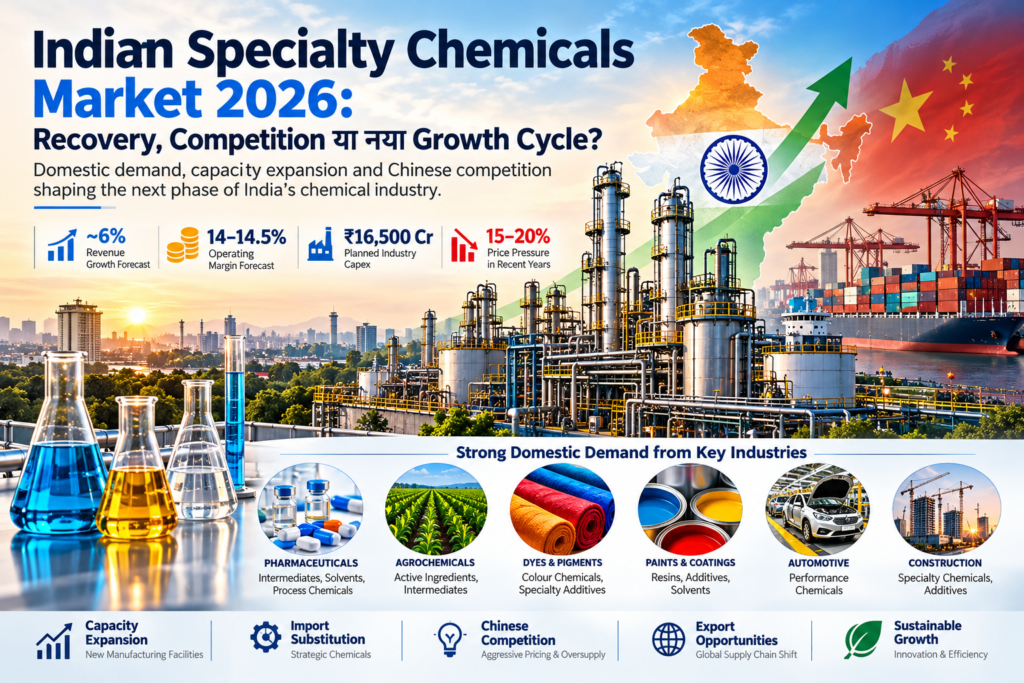
| Specialty chemical revenue growth | Approximately 6% |
| Domestic demand | Relatively strong |
| Operating margin forecast | 14–14.5% |
| Planned industry capex | Approximately ₹16,500 crore |
| Main competitive pressure | Chinese imports and global oversupply |
These figures reflect CRISIL Ratings’ July 2026 assessment, rather than audited results for the entire industry. CRISIL
2. Domestic Demand: The Biggest Growth Driver
One of the strongest positives for India’s chemical industry is the growing domestic consumption of specialty and industrial chemicals.
Several industries continue to generate demand for chemical intermediates, solvents, additives and performance chemicals.
Manufacturing Facilities | Tatva Chintan Pharma Chem Limited
Hikal – Overview | Crop Protection
Why Automotive Plants in India Need India-Specific Industrial Coating Solutions | Chanda Paints
8
Major demand-driving sectors
A. Pharmaceuticals
India’s pharmaceutical manufacturing ecosystem requires a wide range of chemical inputs, including:
- Pharmaceutical intermediates
- Solvents such as IPA, Acetone, DMF and THF
- Reagents and process chemicals
- Specialty intermediates and fine chemicals
Growing pharmaceutical production and outsourcing opportunities continue to support demand for reliable chemical suppliers.
B. Agrochemicals
Agrochemical manufacturers require active ingredients, intermediates, solvents and formulation chemicals.
Domestic demand remains an important support, although export demand and seasonal conditions can influence production.
C. Dyes and Pigments
India’s textile, printing, coatings and pigment industries create demand for colour chemicals, intermediates and specialty additives.
D. Paints, Coatings and Construction
Infrastructure development, automotive production and construction activity are supporting demand for resins, additives, solvents and performance chemicals.
According to CRISIL’s July 2026 analysis, agrochemicals, dyes and pigments, and flavours and fragrances account for approximately 30%, 22% and 14% of domestic specialty chemical sales, respectively. CRISIL
3. Capacity Expansion: Indian Manufacturers Are Preparing for the Future
Capacity expansion is one of the most important developments in the Indian chemical industry.
Manufacturers are increasingly investing in:
- Backward integration to reduce dependence on imported raw materials.
- New manufacturing facilities for specialty intermediates.
- Import substitution for strategically important chemicals.
- Niche and high-value chemical products.
- Process efficiency, automation and sustainable manufacturing.
However, 2026 is also a year of financial discipline.
CRISIL estimates that specialty chemical manufacturers will moderate capital expenditure to approximately ₹16,500 crore in FY2027, with investments focused on backward integration, import substitution and niche chemistries. CRISIL+1
What does this mean for the market?
More manufacturing capacity does not automatically mean higher profitability.
If new capacity enters the market faster than demand grows, manufacturers may face lower utilisation, increased competition and pressure on selling prices.
The companies that invest in the right products, secure raw material sources and build long-term customer relationships are likely to perform better.
4. Chinese Competition: The Biggest Challenge for Indian Manufacturers
Revised Maritime Code 2026: Shipper Liability for Unclaimed Cargo
8
China remains a major force in the global chemical supply chain.
Its manufacturing scale, integrated raw material ecosystem, large production capacities and competitive pricing give Chinese suppliers a significant advantage in several chemical categories.
How is Chinese competition affecting India?
1. Aggressive pricing
Excess production capacity in China has increased the availability of competitively priced chemicals in international markets.
2. Pressure on Indian manufacturers
Indian manufacturers are finding it difficult to increase selling prices, even when raw material and operating costs rise.
3. Import dependency
Indian buyers may prefer imported materials when the landed cost, specifications and delivery terms are more attractive than domestic alternatives.
4. Export competition
Indian manufacturers also face increased competition in international markets, particularly in products where Chinese suppliers have substantial scale advantages.
CRISIL reported that chemical realisations declined by approximately 15–20% between FY2024 and FY2025, reflecting aggressive competition and pricing pressure. CRISIL
McKinsey’s March 2026 industry analysis also highlights China’s structural overcapacity as a major factor affecting global chemical prices and industry profitability. McKinsey & Company
India vs China: Competitive landscape
| Factor | India | China |
|---|---|---|
| Manufacturing scale | Expanding | Large established base |
| Raw material integration | Improving | Strong in many segments |
| Domestic demand | Strong growth opportunity | Large established market |
| Pricing competition | Under pressure | Strong price competition |
| Specialty innovation | Growing | Established capabilities |
| Import substitution | Significant opportunity | Export-driven supply in many products |
Our observation: India should not compete with China only on price. The stronger strategy is to compete through quality consistency, technical support, supply reliability, regulatory compliance and customer relationships.
5. Recovery or Margin Pressure? Understanding the 2026 Numbers
The most interesting development in 2026 is the difference between revenue growth and profitability.
According to CRISIL Ratings’ July 2026 assessment:
Specialty chemical industry: FY2027 forecast
~6%
Revenue growth forecast
14–14.5%
Operating margin forecast
₹16,500 Cr
Estimated capital expenditure
150–200 bps
Expected margin contraction
Source: CRISIL Ratings, July 2, 2026. Forecasts are not final FY2027 actuals. CRISIL
This indicates that revenue growth alone will not determine the success of chemical manufacturers.
Companies must also focus on:
- Raw material procurement efficiency.
- Inventory management.
- Working capital control.
- Production cost optimisation.
- Customer diversification.
- Better product mix and value addition.
The next growth cycle may reward companies with stronger operational discipline rather than simply larger production capacities.
6. Opportunities for Chemical Traders and Distributors
The changing market environment is creating opportunities not only for manufacturers but also for organised chemical trading and distribution companies.
As buyers become more cost-conscious, they increasingly expect suppliers to provide more than just a quotation.
Five important opportunities for chemical traders in 2026:
- Import sourcing: Identify reliable international manufacturers offering competitive landed costs.
- Domestic manufacturer partnerships: Develop direct relationships with Indian manufacturing units.
- Ready stock availability: Maintain inventory of regularly consumed industrial solvents and intermediates.
- Quality assurance: Provide COA, SDS, batch traceability and consistent product specifications.
- Supply chain reliability: Offer timely delivery, transparent commercial terms and dependable service.
For example, products such as IPA, Acetone, DMF, THF, MEK, MIBK and other pharmaceutical and industrial solvents remain relevant to multiple manufacturing supply chains.
For distributors, the opportunity is to build a dependable bridge between manufacturers and end-user industries.
7. What Should the Chemical Industry Expect in 2027?
The outlook will depend on several important factors.
| Growth factor | What to monitor |
|---|---|
| Domestic consumption | Pharma, agrochemical and industrial demand |
| Chinese competition | Import prices and global capacity utilisation |
| Raw materials | Crude-linked feedstock and intermediate costs |
| Capacity expansion | New plant commissioning and utilisation |
| Exports | Global procurement and trade normalisation |
| Profitability | Ability to pass on cost increases |
Three possible scenarios can shape the next phase:
Scenario 1: Strong recovery
Domestic demand improves, exports recover and global oversupply gradually eases. Manufacturers regain pricing power.
Scenario 2: Volume growth with margin pressure
Demand continues growing, but Chinese competition prevents meaningful price increases. Revenue improves while profitability remains under pressure.
Scenario 3: Renewed market slowdown
Global economic uncertainty, higher feedstock prices or additional capacity additions create fresh pressure on demand and margins.
The second scenario is an important possibility to watch because it reflects the current balance between domestic demand strength and international pricing pressure.
8. Conclusion: A New Growth Cycle, But With a Different Strategy
The Indian specialty chemicals industry is not simply returning to its previous growth phase. It is entering a more competitive and disciplined business environment.
Domestic demand, manufacturing investments, import substitution and India’s growing role in global supply chains provide strong long-term opportunities.
However, Chinese competition, global oversupply, raw material volatility and pressure on operating margins will continue to challenge manufacturers.
The winners of the next growth cycle will not necessarily be the companies producing the largest volumes. They will be the companies delivering the right quality, at the right price, with reliable supply and sustainable margins.
For manufacturers, traders, distributors and procurement professionals, 2026 is a time to rethink sourcing strategies, strengthen partnerships and prepare for the next phase of India’s chemical industry.


