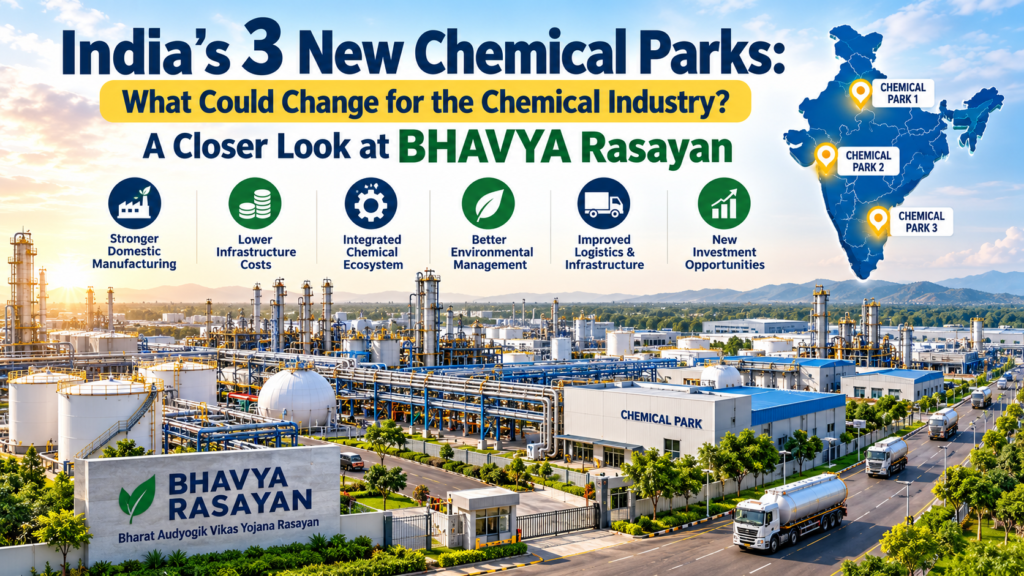
Introduction: A New Chapter for India’s Chemical Industry
India’s chemical industry is entering a potentially important phase of development. As global manufacturers look for diversified supply chains and reliable sourcing destinations, India has an opportunity to strengthen its position as a competitive chemical manufacturing hub.
However, expanding chemical production requires more than investment in machinery and technology. Manufacturers also need reliable utilities, efficient logistics, safe chemical storage, solvent recovery facilities, waste treatment systems and predictable regulatory processes.
These infrastructure requirements can be particularly challenging for small and medium-sized chemical manufacturers.
Against this backdrop, the Government of India has introduced BHAVYA Rasayan (Bharat Audyogik Vikas Yojana Rasayan), a scheme designed to support the development of three dedicated chemical parks across India.
Announced in the Union Budget 2026–27 and subsequently approved by the Union Cabinet, the initiative aims to strengthen domestic chemical production, reduce import dependence and improve India’s competitiveness in global markets.
The scheme is especially relevant for manufacturers, chemical traders, distributors, investors and downstream industries that depend on reliable chemical supplies.
But what exactly is BHAVYA Rasayan, and how could it change the way India’s chemical industry operates?
Let’s examine its objectives, potential impact and business opportunities.
1. What Is BHAVYA Rasayan?
BHAVYA Rasayan is a government scheme intended to support states in developing three dedicated chemical parks through a competitive, challenge-based selection process.
According to the Government of India’s official announcement, the scheme has a total financial outlay of ₹3,030 crore and is scheduled to run for five years, from FY 2026–27 to FY 2030–31.
The initiative is designed to establish integrated industrial ecosystems where chemical manufacturers can access common infrastructure and essential utilities rather than developing every facility independently.
Key highlights of the scheme
- Number of proposed parks: Three
- Total scheme outlay: ₹3,030 crore
- Central grant: Up to ₹1,000 crore per park
- Minimum state government contribution: ₹500 crore per park
- Implementation period: FY 2026–27 to FY 2030–31
- Minimum contiguous land requirement: 8 square kilometres, equivalent to approximately 2,000 acres, per park
- Selection method: Challenge-based selection of state proposals
The proposed parks are expected to provide facilities such as common effluent treatment plants, hazardous waste management infrastructure, solvent recovery and distillation facilities, water distribution systems, steam networks, pipelines, warehouses and logistics services.
These shared facilities are intended to reduce infrastructure duplication and make chemical manufacturing more efficient.
Source: Prime Minister of India — BHAVYA Rasayan Scheme.
2. Why Does India Need Three New Chemical Parks?
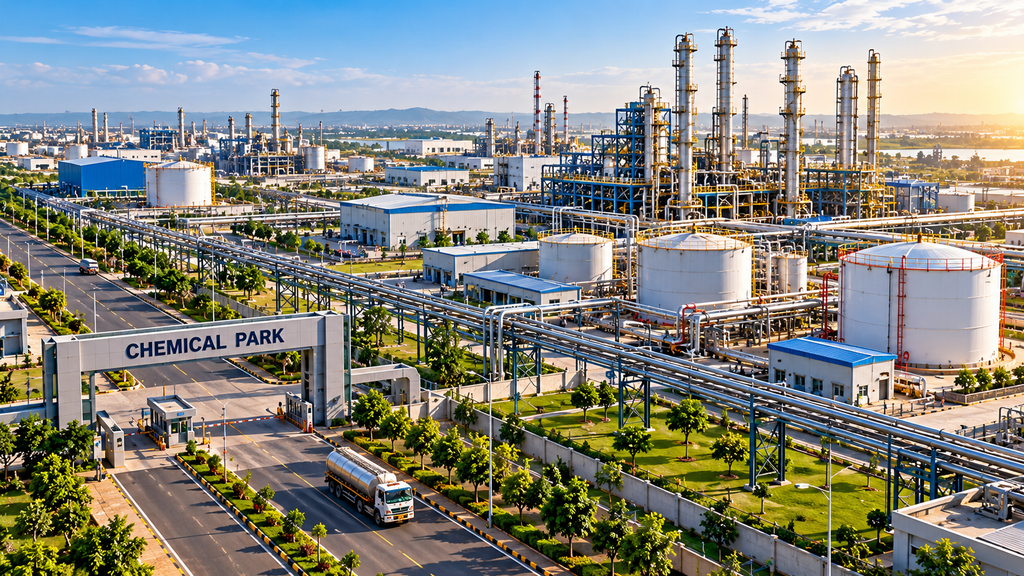
India already has established chemical manufacturing clusters in Gujarat, Maharashtra, Rajasthan, Tamil Nadu, Andhra Pradesh and other states.
Gujarat, in particular, has a strong chemical manufacturing ecosystem supported by industrial locations such as Ankleshwar, Bharuch, Dahej, Vapi, Vadodara, Ahmedabad and surrounding industrial estates.
Yet the existence of established clusters does not eliminate every infrastructure challenge.
Individual manufacturers may still need to invest separately in utilities, wastewater treatment, hazardous waste management, solvent recovery, storage and internal logistics.
For smaller companies, these investments can increase the cost of establishing a new manufacturing unit.
BHAVYA Rasayan seeks to address this challenge through a shared-infrastructure model.
The central idea: shared infrastructure, stronger manufacturing
Under a traditional industrial setup, companies may have to arrange several infrastructure requirements independently.
Under a well-developed chemical park, participating companies could access common facilities designed specifically for chemical manufacturing.
This could provide several advantages:
- Lower initial infrastructure investment for eligible manufacturing units.
- Faster establishment of new manufacturing capacity.
- More efficient movement and handling of raw materials.
- Improved access to waste treatment and solvent recovery facilities.
- Greater opportunities for collaboration between upstream and downstream manufacturers.
The actual benefits will depend on how the parks are designed, financed, operated and connected to suppliers and customers.
3. What Could Change for Chemical Manufacturers?
The most significant impact of BHAVYA Rasayan could be a shift towards more integrated and infrastructure-efficient chemical manufacturing.
A. Lower infrastructure costs
Chemical manufacturing often requires specialised utilities, storage systems, safety installations and environmental management facilities.
Developing these facilities independently can require significant capital expenditure.
If chemical parks provide reliable common infrastructure, manufacturers may be able to reduce the amount of capital tied up in supporting facilities.
This could make it easier for companies to evaluate new production lines, expand capacity or enter additional chemical segments.
However, savings will vary according to the type of chemical manufactured, infrastructure charges, regulatory requirements and the company’s operating model.
B. Faster project development
A manufacturing project can face delays when utilities, environmental infrastructure, land development and other supporting services are not available at the right time.
A properly developed chemical park could reduce some of these delays by providing planned infrastructure before individual units begin operations.
This would be particularly valuable for manufacturers planning to expand production in response to new customer demand.
Nevertheless, common infrastructure does not automatically guarantee faster approvals. Companies will still need to meet applicable environmental, safety and regulatory requirements.
C. Better integration across the chemical value chain
Chemical manufacturing depends on a connected network of suppliers and buyers.
For example, a basic chemical producer may supply raw materials to an intermediate manufacturer. That intermediate may then be used by a pharmaceutical, agrochemical, polymer or specialty chemical manufacturer.
When these businesses operate within a connected industrial ecosystem, material movement and industrial coordination may become more efficient.
The proposed parks could support greater integration between:
- Basic and bulk chemical manufacturers.
- Chemical intermediate producers.
- Specialty chemical manufacturers.
- Solvent recovery and recycling businesses.
- Downstream formulation and processing companies.
- Warehousing, packaging and logistics providers.
This integration could create new opportunities for domestic suppliers and help manufacturers improve their supply-chain resilience.
4. Could BHAVYA Rasayan Reduce India’s Dependence on Chemical Imports?
Reducing import dependence is one of the scheme’s central objectives.
India imports a wide range of chemicals and intermediates used across pharmaceutical manufacturing, agrochemicals, coatings, textiles, electronics and other industries.
Some imports are necessary because of technology requirements, production economics, specialised quality specifications or limited domestic capacity.
Chemical parks alone cannot eliminate these dependencies. However, they could help improve the economics of domestic manufacturing by making infrastructure and supporting services more accessible.
Potential areas of opportunity
Chemical intermediates: Domestic manufacturers may find it easier to establish or expand production capacity where infrastructure costs are a major barrier.
Specialty chemicals: Integrated facilities could support manufacturers developing specialised products for pharmaceuticals, coatings, electronics and industrial applications.
Solvents: Shared storage, handling, recovery and distribution infrastructure could improve operational efficiency for suitable solvent manufacturers and users.
Downstream chemicals: Better connections between raw material suppliers and downstream industries could encourage local value addition.
Export-oriented manufacturing: More competitive production costs and reliable infrastructure could help eligible manufacturers serve international customers.
Import substitution will still depend on product quality, cost competitiveness, production technology, regulatory compliance and dependable supply.
The long-term opportunity is not simply to manufacture more chemicals. It is to manufacture the right chemicals at competitive costs and consistent quality.
5. Environmental Management Could Become a Competitive Advantage
Environmental compliance is an important consideration for the chemical industry.
Chemical manufacturers must manage wastewater, process residues, hazardous waste, emissions and other operational risks according to applicable regulations.
For individual manufacturers, developing and maintaining suitable infrastructure can be expensive and technically demanding.
BHAVYA Rasayan envisages common facilities such as:
- Common Effluent Treatment Plants (CETPs).
- Treatment, Storage and Disposal Facilities (TSDFs).
- Hazardous waste management systems.
- Solvent recovery and distillation facilities.
- Shared water distribution and utility networks.
These facilities could help participating manufacturers manage environmental responsibilities more efficiently.
Solvent recovery, in particular, may offer opportunities to recover usable material from suitable process streams, potentially reducing fresh solvent consumption and waste generation.
However, shared facilities must be properly designed, operated, maintained and monitored. Common infrastructure is not a substitute for individual companies’ legal responsibilities, process safety measures or environmental compliance.
A successful chemical park must combine industrial growth with effective environmental management.
6. What Does BHAVYA Rasayan Mean for Gujarat?
Gujarat is one of India’s most established chemical manufacturing states, with a wide network of chemical producers, intermediates manufacturers, traders, logistics providers and downstream industrial customers.
Its existing industrial ecosystem provides a useful context for understanding the potential significance of the new scheme.
The state already has chemical manufacturing and petrochemical activity across several industrial regions, including Bharuch, Ankleshwar, Dahej, Vapi, Vadodara and Ahmedabad.
An additional dedicated chemical park could potentially strengthen this ecosystem if Gujarat submits a competitive proposal and secures selection under the scheme.
Potential advantages could include:
1. Opportunities for new manufacturing investment
Integrated infrastructure could make some projects more attractive to domestic and international investors.
2. Greater demand for industrial services
New manufacturing units could create demand for chemical storage, packaging, transport, testing, engineering and maintenance services.
3. Opportunities for smaller manufacturers
Access to shared facilities could help eligible small and medium-sized enterprises evaluate manufacturing opportunities that would otherwise require substantial standalone infrastructure investment.
4. Stronger domestic supply chains
Better connections between manufacturers, distributors and end users could improve sourcing options for chemical buyers.
5. Additional employment
The construction, operation and supporting services associated with chemical parks could create direct and indirect employment opportunities.
It is important to note that the three parks have been proposed at the national level. Their final locations should not be assumed until the relevant state proposals have been evaluated and official decisions are announced.
7. How Could BHAVYA Rasayan Affect Chemical Traders and Distributors?
The potential impact of the scheme extends beyond manufacturers.
Chemical traders and distributors play an important role in connecting producers with customers across pharmaceuticals, agrochemicals, coatings, textiles and other industries.
As manufacturing capacity expands, the demand for raw materials, solvents, intermediates, packaging, storage and transportation may also change.
For chemical trading companies, this could create several opportunities.
A. New sourcing opportunities
Additional domestic manufacturing capacity may provide access to products that were previously sourced mainly through imports or a limited supplier network.
Traders could evaluate new manufacturers, compare specifications and develop alternative sourcing channels for customers.
B. A wider customer base
New manufacturing units may require regular supplies of solvents, intermediates, process chemicals and other industrial inputs.
Distributors that build strong supplier relationships and understand customer requirements could be well positioned to serve these businesses.
C. More opportunities for import substitution
As domestic production expands, buyers may evaluate Indian alternatives to imported chemicals.
Chemical traders can add value by comparing product specifications, checking quality documentation, assessing commercial terms and coordinating reliable deliveries.
D. Greater importance of technical sourcing
Price alone may not determine purchasing decisions.
Customers will continue to require consistent quality, traceable documentation, reliable delivery, appropriate packaging and technical support.
Traders that can provide these services may be better placed to compete in an evolving chemical market.
For companies such as Crystal ChemiTrade, the key opportunity is to strengthen manufacturer relationships, understand emerging customer requirements and build dependable supply channels as the domestic chemical ecosystem develops.
8. What Challenges Could Limit the Impact?
Although BHAVYA Rasayan has significant potential, its success will depend on execution.
Several factors will influence whether the scheme delivers its intended benefits.
Land and infrastructure readiness
Each selected park must meet the specified land requirements and develop the necessary supporting infrastructure. Delays in land preparation, utilities or construction could affect project timelines.
Environmental and safety standards
Chemical parks require robust systems for wastewater treatment, hazardous waste, fire protection, emergency response and industrial safety.
These systems must remain effective throughout the life of the park.
Availability of suitable manufacturers
A chemical park becomes more valuable when it attracts a complementary mix of manufacturers, suppliers and service providers.
The right industrial mix will be important for creating meaningful supply-chain efficiencies.
Commercial viability
Shared infrastructure must be affordable, dependable and professionally managed. High service charges or unreliable utilities could reduce the advantages for participating businesses.
Skilled manpower and technology
Modern chemical manufacturing requires trained personnel, suitable process technology, quality systems and strong operational discipline.
Infrastructure investment must be supported by these capabilities.
Regulatory coordination
Chemical manufacturing involves multiple regulatory requirements. Efficient coordination between relevant authorities will be important, while maintaining the required standards of environmental protection and safety.
The scheme should therefore be viewed as an enabling framework rather than a guarantee of lower costs or immediate growth.
9. What Should Chemical Industry Businesses Do Now?
Manufacturers, traders and investors do not need to wait until all three parks become operational to prepare for potential changes.
Businesses can begin by reviewing their sourcing strategies, expansion plans and customer requirements.
For manufacturers
- Identify products where domestic manufacturing could become more competitive.
- Evaluate infrastructure and utility requirements for potential expansion.
- Assess the availability of raw materials and downstream customers.
- Review environmental compliance, process safety and quality systems.
- Monitor official announcements regarding the selected parks.
For chemical traders
- Develop relationships with established and emerging domestic manufacturers.
- Track chemicals that customers currently import or struggle to source reliably.
- Build a verified database of manufacturers, product specifications and commercial terms.
- Strengthen quality documentation, logistics coordination and customer service.
- Identify opportunities to support new manufacturing units as their sourcing requirements become clearer.
For investors
- Assess demand fundamentals, production economics and supply-chain opportunities.
- Study the proposed park’s infrastructure plan, location and connectivity.
- Review the eligibility criteria and applicable investment framework before making commitments.
- Distinguish confirmed government decisions from future expectations.
Businesses should base investment decisions on verified information, actual customer demand and realistic operating assumptions.
10. What Happens Next? The Implementation Timeline Matters
The Union Cabinet approved the BHAVYA Rasayan Scheme on 24 July 2026, and the Department of Chemicals and Petrochemicals subsequently issued implementation guidelines.
As of 27 October 2026, the Department’s official scheme page states that states must submit their proposals by 30 November 2026.
This makes the coming weeks particularly important for states considering participation.
The next milestones to monitor include:
- Submission of state government proposals.
- Evaluation and selection of the three chemical parks.
- Finalisation of project plans and common infrastructure requirements.
- Development of land, utilities and environmental facilities.
- Investment decisions and participation by manufacturers.
- Construction, commissioning and eventual operation of the parks.
The pace and outcome of these steps will determine when the proposed infrastructure begins to deliver practical benefits to manufacturers and their customers.
Official source: Department of Chemicals and Petrochemicals — BHAVYA Rasayan Scheme.
Conclusion: Could BHAVYA Rasayan Reshape India’s Chemical Industry?
India’s proposed three chemical parks represent an important effort to strengthen the infrastructure supporting domestic chemical manufacturing.
Through common utilities, integrated logistics, solvent recovery, wastewater treatment and hazardous waste management, the BHAVYA Rasayan Scheme aims to address some of the structural challenges that can affect industrial competitiveness.
If implemented effectively, the initiative could help manufacturers improve operating efficiency, evaluate new investments, strengthen domestic supply chains and compete more effectively in selected chemical segments.
The potential benefits could extend beyond manufacturing to chemical distributors, logistics providers, packaging companies, service providers and downstream industrial users.
For Gujarat’s established chemical ecosystem, the scheme presents a development opportunity worth watching closely. However, the actual impact will depend on the selection of suitable locations, timely infrastructure development, effective environmental management and the ability to attract viable manufacturing investments.
For chemical businesses, the most practical response is to prepare early: strengthen sourcing networks, understand customer demand, monitor policy developments and focus on quality, reliability and cost competitiveness.
BHAVYA Rasayan is a promising infrastructure initiative, but its real significance will ultimately be measured by the manufacturing capacity it enables, the supply chains it strengthens and the sustainable industrial growth it delivers.
Frequently Asked Questions (FAQs)
1. What is BHAVYA Rasayan?
BHAVYA Rasayan stands for Bharat Audyogik Vikas Yojana Rasayan. It is a Government of India scheme to support the establishment of three dedicated chemical parks through a challenge-based selection process.
2. What is the total budget for BHAVYA Rasayan?
The scheme has a total financial outlay of ₹3,030 crore, including ₹3,000 crore for common infrastructure and basic utilities and ₹30 crore for administrative expenditure.
3. Where will the three chemical parks be established?
The locations depend on the selection process for state government proposals. Final locations should be confirmed through official government announcements.
4. How could chemical parks benefit manufacturers?
They could provide shared infrastructure, utilities, logistics and environmental facilities, potentially reducing infrastructure duplication and improving manufacturing efficiency.
5. Will BHAVYA Rasayan reduce India’s chemical imports?
That is one of the scheme’s objectives. The extent of import substitution will depend on the products manufactured, domestic production costs, quality, demand and competitiveness.
6. Can chemical traders benefit from the scheme?
Potentially. New manufacturing investments could create sourcing and distribution opportunities. Traders will need to identify actual customer requirements and verify supplier capabilities.
7. What is the deadline for states to submit proposals?
As stated on the Department of Chemicals and Petrochemicals’ official scheme page, the deadline is 30 November 2026.