
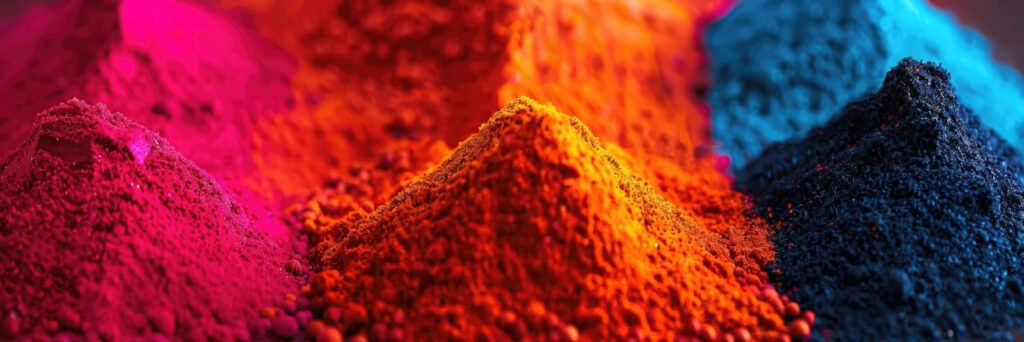
Dyes and pigments are essential coloring agents that bring vibrancy, identity, and aesthetic value to a vast spectrum of manufactured goods. From textiles and plastics to paints, inks, and cosmetics, these chemical compounds are meticulously formulated to impart lasting color stability, visual appeal, and functional performance across diverse industrial sectors.
What are Dyes and Pigments?
Dyes and pigments are both substances that impart color, but they differ fundamentally in their solubility and interaction with materials. Dyes are soluble organic compounds that dissolve completely in a liquid medium, penetrating deep into the fiber or substrate molecularly. Pigments are insoluble colored particles that remain as fine crystallites, adhering to surfaces or binding within a medium to provide color through surface reflection.
What is Their Use?
- Textile and Fabric Coloring: Dyeing cotton, polyester, silk, and blended fabrics to produce stable, fade-resistant apparel.
- Coatings and Paints: Imparting rich colors, opacity, and weather resistance to architectural and industrial coatings.
- Plastics and Polymers: Coloring raw plastic granules used in automotive parts, packaging, and consumer goods.
- Printing Inks: Providing precise color formulation for packaging, magazines, commercial printing, and digital printing inks.
Key Benefits of Dyes and Pigments
- High Color Fastness: Resists fading caused by UV exposure, washing, heat, and chemical wear.
- Versatility: Adaptable across various physical states and chemical formulations, ensuring compatibility with diverse manufacturing processes.
- Aesthetic and Brand Value: Enhances product appearance, consumer recognition, and emotional appeal on retail shelves.
- Functional Properties: Certain specialty pigments provide added benefits such as corrosion resistance, thermal stability, or UV protection.
Common Types of Dyes and Pigments Used in Industry
- Reactive and Direct Dyes: Primarily utilized for coloring cotton, cellulose fibers, and paper.
- Disperse Dyes: Specially formulated for synthetic fibers like polyester and nylon.
- Azo Pigments: Organic pigments providing bright red, yellow, and orange shades for inks and plastics.
- Phthalo Blue and Green: High-performance synthetic organic pigments known for exceptional lightfastness and chemical resistance.
- Inorganic Pigments: Metal oxides and titanium dioxide used extensively for superior opacity, durability, and whiteness.