
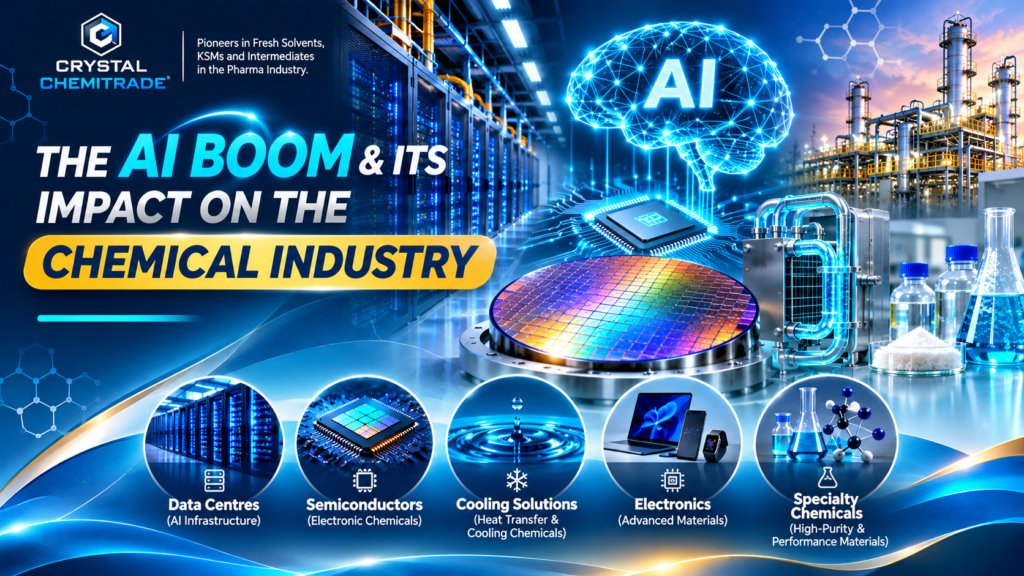
How Artificial Intelligence Is Creating New Opportunities in Data Centres, Semiconductors, Cooling & Specialty Chemicals
Introduction: AI Is More Than Just Technology
Artificial Intelligence (AI) is transforming the world at an extraordinary speed. From ChatGPT and automated manufacturing to advanced robotics and autonomous systems, AI is changing how businesses operate.
But behind every AI application lies a massive physical infrastructure.
AI requires powerful data centres, advanced semiconductor chips, sophisticated electronic components, high-performance cooling systems and specialised materials. All these industries depend on one important sector: THE CHEMICAL INDUSTRY.
The AI revolution is therefore not just a software revolution. It is also creating a new wave of demand for chemicals, industrial materials and specialty chemical solutions.
1. Data Centres: The New Growth Engine
AI models require enormous computing power. To support this demand, companies worldwide are investing heavily in data centres.
These facilities require:
- Advanced electronic components.
- High-purity cleaning chemicals.
- Cooling fluids and water-treatment chemicals.
- Industrial gases.
- Electrical insulation materials.
- Specialised polymers and engineering materials.
According to the International Energy Agency (IEA), global data-centre electricity consumption is projected to nearly double from approximately 485 TWh in 2025 to 950 TWh by 2030.
This expansion creates opportunities across the chemical supply chain.
2. Semiconductor Industry: High Demand for Specialty Chemicals
Semiconductors are the backbone of AI technology. Every advanced AI processor requires sophisticated manufacturing processes involving highly specialised materials.
Important chemical categories include:
- Electronic-grade Isopropyl Alcohol (IPA)
- Electronic-grade Acetone
- Hydrogen Peroxide
- Sulphuric Acid
- Ammonium Hydroxide
- Hydrofluoric Acid
- Photoresists and speciality developers
- Ultra-high-purity industrial gases
These materials are used in wafer cleaning, etching, surface preparation and other semiconductor manufacturing processes.
The opportunity: As semiconductor manufacturing capacity expands, demand for reliable, high-purity chemical suppliers is expected to increase.
An important distinction: semiconductor manufacturing requires stringent purity specifications. Ordinary industrial or laboratory grades cannot automatically be considered semiconductor-grade materials.
3. Cooling Technology: A New Chemical Opportunity
One of the biggest challenges in AI infrastructure is heat generation.
High-performance AI servers and GPUs generate significant heat, making advanced cooling technologies essential.
This is creating opportunities in:
- Dielectric cooling fluids
- Heat-transfer fluids
- Glycol-based cooling solutions
- Corrosion inhibitors
- Water-treatment chemicals
- Speciality cooling additives
Liquid cooling technologies are attracting growing attention because conventional air cooling can become less practical as computing density increases.
The chemical industry has an important role in developing and supplying materials that support efficient, reliable and sustainable cooling systems.
4. Electronics & Advanced Materials
AI is also accelerating demand for electronic components, printed circuit boards, batteries, sensors and advanced computing hardware.
These industries require various chemical materials, including:
- Electronic-grade solvents
- Epoxy resins
- Speciality polymers
- Conductive materials
- High-purity cleaning agents
- Adhesives and coating chemicals
As electronic manufacturing expands, chemical manufacturers and distributors can explore new industrial customer segments.
5. Specialty Chemicals: The Next Big Opportunity
The future of the chemical industry will not depend only on conventional bulk chemicals.
High-performance and application-specific materials are becoming increasingly important.
Some promising areas include:
| Industry | Chemical opportunity |
|---|---|
| Semiconductor | Ultra-pure solvents and electronic chemicals |
| Data Centres | Cooling fluids and water-treatment chemicals |
| Electronics | Speciality coatings and polymers |
| Batteries | Electrolytes and advanced materials |
| Industrial Infrastructure | Heat-transfer fluids and corrosion inhibitors |
| Advanced Manufacturing | High-performance speciality chemicals |
The biggest opportunity will be in supplying products that meet specific technical, quality and purity requirements.
6. What Does This Mean for India’s Chemical Industry?
India has an opportunity to strengthen its position in the global chemical and semiconductor supply chains.
With growing interest in domestic electronics manufacturing, semiconductor investments and industrial infrastructure, demand for specialised chemical materials could create new business opportunities.
The Indian chemical industry can focus on:
- Developing high-purity chemical manufacturing capabilities.
- Strengthening domestic supply chains.
- Investing in speciality chemical research and development.
- Building international sourcing partnerships.
- Improving quality standards and product traceability.
- Supporting semiconductor and electronics manufacturers with reliable chemical supplies.
This transition can create opportunities for chemical manufacturers, importers, exporters, distributors and speciality chemical suppliers.
7. The Future: Chemistry Will Power the AI Revolution
Artificial Intelligence may be developed through software and algorithms, but its infrastructure depends on physical materials, manufacturing capabilities and chemical innovation.
From semiconductor fabrication to advanced cooling systems, chemicals will remain an essential part of the AI ecosystem.
Companies that understand these emerging requirements and build reliable sourcing networks will be better positioned to participate in the next phase of industrial growth.
Crystal ChemiTrade’s Perspective
At Crystal ChemiTrade, we believe the future of the chemical industry will be shaped by innovation, quality, technology and strong supply-chain partnerships.
The AI revolution is opening new opportunities across electronics, semiconductor materials, industrial cooling and specialty chemicals.
Our vision is to stay connected with evolving industrial requirements and explore opportunities in emerging chemical markets.
Because the future of technology is not powered by software alone. It is also powered by chemistry.
CONCLUSION
AI is transforming technology. Semiconductors are powering AI. And chemistry is helping build the infrastructure behind both.
The next industrial revolution will create opportunities not only for technology companies but also for the chemical industry worldwide.
Crystal ChemiTrade – Connecting Industries Through Reliable Chemical Supply.

