Introduction
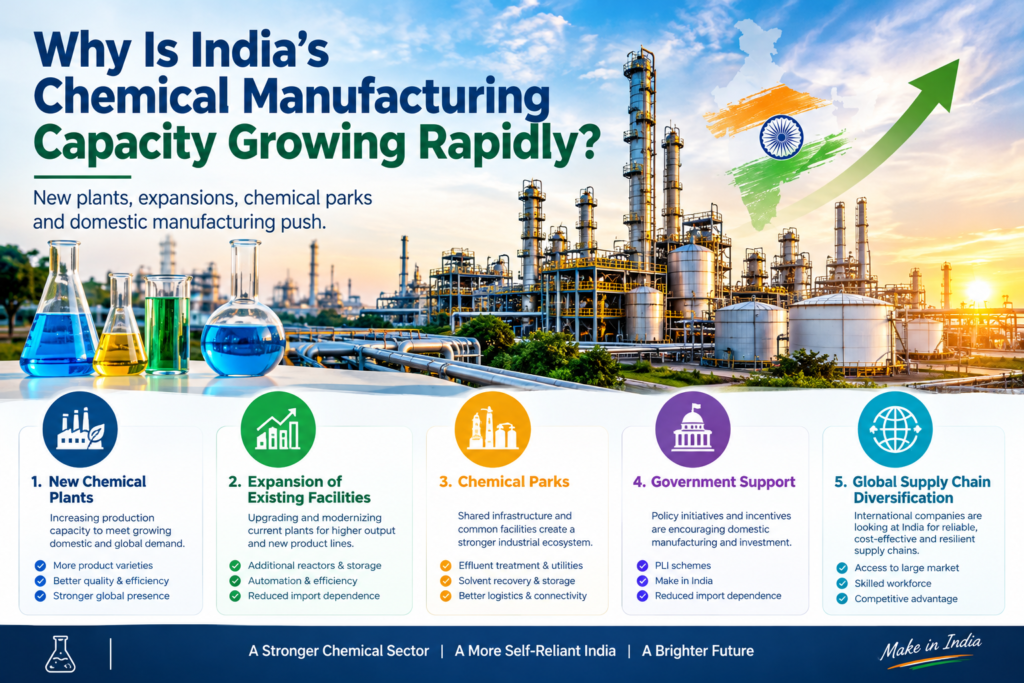
India’s chemical industry is experiencing a major transformation. With new manufacturing plants, expansion of existing facilities, the development of chemical parks, and strong government support for domestic production, India is strengthening its position as a global chemical manufacturing hub.
Chemicals are essential to a wide range of industries, including pharmaceuticals, agriculture, textiles, paints and coatings, plastics, automotive, construction, electronics, and personal care. As demand grows in India and international markets, chemical manufacturers are investing in additional production capacity, modern technology, and improved infrastructure.
But what is driving this rapid growth, and what does it mean for manufacturers, importers, distributors, and chemical traders?
1. New Chemical Plants Are Increasing Production Capacity
One of the main reasons for the growth of India’s chemical industry is the establishment of new manufacturing facilities.
Companies are investing in new plants to meet increasing demand for industrial chemicals, specialty chemicals, pharmaceutical intermediates, polymers, solvents, and other essential raw materials.
New facilities can help manufacturers:
- Increase overall production capacity.
- Improve product quality and consistency.
- Introduce new chemical products.
- Reduce production bottlenecks.
- Serve domestic and international customers more efficiently.
Several industrial regions, particularly Gujarat, Maharashtra, Andhra Pradesh, Odisha, and Tamil Nadu, are important destinations for chemical manufacturing investments.
Gujarat has a particularly strong position because of its industrial infrastructure, ports, established chemical clusters, logistics facilities, and access to domestic and international markets.
2. Existing Manufacturers Are Expanding Their Plants
Growth is not limited to new factories. Many existing manufacturers are expanding their production facilities to meet rising demand and strengthen their competitive position.
Plant expansions may involve installing additional reactors, increasing storage capacity, upgrading production lines, improving automation, and adding new product categories.
For example, a manufacturer that previously produced basic industrial chemicals may invest in specialty chemicals or higher-value intermediates to serve pharmaceutical, agrochemical, coating, or polymer industries.
Expansions can also help companies improve operational efficiency and reduce dependence on external suppliers for selected raw materials.
For the chemical supply chain, this creates opportunities for raw-material suppliers, packaging companies, logistics providers, distributors, and chemical trading businesses.
3. Chemical Parks Are Creating a Stronger Industrial Ecosystem
Chemical parks are among the most important developments supporting India’s manufacturing growth.
A chemical park brings related industries together in one organised industrial area. Instead of every company independently arranging all its infrastructure, manufacturers can benefit from shared facilities and industrial services.
In July 2026, the Union Cabinet approved the BHAVYA Rasayan Scheme, with a total financial outlay of ₹3,030 crore to support the development of three dedicated chemical parks. The scheme aims to improve infrastructure, strengthen domestic production, reduce import dependence, and increase competitiveness.
रसायन एवं पेट्रोरसायन विभाग
+1
Key facilities planned for chemical parks can include:
- Common effluent treatment plants and waste-management facilities.
- Reliable power, steam, water, and other utilities.
- Solvent recovery and distillation facilities.
- Storage, warehousing, and pipeline infrastructure.
- Better connectivity to transport and logistics networks.
These facilities can reduce infrastructure costs and make it easier for manufacturers to establish new units or expand existing operations.

India also has established Petroleum, Chemicals and Petrochemicals Investment Regions (PCPIRs), including Dahej in Gujarat, Visakhapatnam–Kakinada in Andhra Pradesh, and Paradeep in Odisha. According to the Department of Chemicals and Petrochemicals, these regions have attracted substantial investment and generated significant employment.
Press Information Bureau
+1
4. Government Support Is Encouraging Domestic Manufacturing
Government policies are another important factor behind the expansion of India’s chemical industry.
Initiatives supporting manufacturing, industrial infrastructure, investment, and supply-chain development encourage companies to consider India as a location for new production facilities.
The broader domestic manufacturing push aims to strengthen local production, improve industrial competitiveness, create employment, and reduce excessive dependence on imported materials.
For example, the Production Linked Incentive (PLI) scheme for bulk drugs supports domestic manufacturing of selected critical key starting materials, drug intermediates, and active pharmaceutical ingredients. By December 2025, 38 projects under the scheme had been commissioned, establishing approximately 56,800 metric tonnes per year of manufacturing capacity.
Press Information Bureau
Although pharmaceutical ingredients represent a specific segment of the wider chemical industry, such initiatives demonstrate how targeted support can encourage investment in domestic chemical production.
5. Reducing Import Dependence Is a Major Priority
India has a large and diverse chemical market, but certain chemical products, intermediates, and specialised raw materials continue to rely on imports.
Dependence on imported materials can expose manufacturers to international price fluctuations, freight costs, currency movements, geopolitical disruptions, and supply delays.
Increasing domestic manufacturing capacity can help address these challenges by providing more local sourcing options.
However, import substitution does not happen automatically. Domestic manufacturers must offer competitive prices, consistent quality, dependable delivery, and the technical specifications required by buyers.
The opportunity is particularly relevant for products where domestic demand is strong and local production can become commercially competitive.
6. Global Companies Are Diversifying Their Supply Chains
International businesses increasingly assess where they should manufacture and source products to balance cost, quality, resilience, and access to markets.
India can benefit from this trend because of its established industrial base, skilled workforce, large domestic market, port connectivity, and experience in pharmaceuticals, agrochemicals, specialty chemicals, and other manufacturing segments.
For international companies, India can serve as a manufacturing destination, a sourcing market, or a partner for selected stages of the chemical value chain.
To capture these opportunities, Indian manufacturers need to strengthen technology, product quality, research and development, regulatory compliance, environmental performance, and delivery reliability.
7. Specialty Chemicals Are Creating New Growth Opportunities
The industry is not growing only through bulk chemicals. Specialty chemicals and application-specific products are also important areas of development.
These products are used in industries such as:
- Pharmaceuticals and healthcare.
- Agrochemicals and crop protection.
- Paints, coatings, and adhesives.
- Electronics and advanced materials.
- Automotive and construction.
- Water treatment and industrial cleaning.
- Personal care and consumer products.
Specialty chemicals often require more technical knowledge, specialised manufacturing processes, and consistent quality control than standard commodity products.
As customer requirements evolve, manufacturers that develop reliable products for specific applications may be able to access new markets and build stronger long-term customer relationships.

8. What Does This Growth Mean for Chemical Traders?
The expansion of manufacturing capacity creates opportunities beyond the factories themselves. Chemical traders and distributors can play an important role by connecting manufacturers with buyers and helping businesses source the materials they need.
Potential opportunities include:
Raw-material supply: Supplying solvents, acids, alkalis, intermediates, additives, and other approved materials to manufacturers.
Local distribution: Helping manufacturers reach customers across Gujarat and other industrial regions.
Import and domestic sourcing: Comparing domestic suppliers with import options based on price, quality, availability, and delivery terms.
Specialty product sourcing: Identifying products required by pharmaceutical, agrochemical, coating, textile, and polymer manufacturers.
Supply-chain support: Providing reliable documentation, timely deliveries, and consistent communication between suppliers and buyers.

For a chemical trading business, the most effective strategy is to focus on specific products and industries rather than attempting to supply every chemical in the market. Understanding product specifications, safety documentation, minimum order quantities, payment terms, and customer demand can help build a sustainable business.
9. Challenges That Could Affect Future Growth
Despite the positive outlook, India’s chemical industry faces several challenges.
These include fluctuating raw-material prices, international competition, infrastructure costs, environmental regulations, waste treatment, energy consumption, access to technology, and the need for skilled workers.
Manufacturers must also ensure safe handling, storage, transportation, and disposal practices.
Chemical parks and new factories can support industrial growth, but their long-term success will depend on efficient implementation, responsible environmental management, access to utilities, and the ability to attract commercially viable manufacturing units.
Growth in installed capacity must ultimately translate into competitive production, reliable sales, and sustainable profitability.
10. The Road Ahead for India’s Chemical Industry
India’s chemical manufacturing sector has the potential to become more competitive through continued investment in infrastructure, new plants, plant expansions, technology, and domestic sourcing.
Chemical parks may help create stronger connections between raw-material suppliers, manufacturers, logistics providers, and downstream industries. Government initiatives can support this transition, while private investment and innovation will remain essential to long-term success.
The future will depend not only on how much capacity India builds, but also on how efficiently that capacity is used, how consistently manufacturers meet quality standards, and how effectively Indian companies compete in global markets.
Conclusion
India’s chemical manufacturing capacity is growing because of rising domestic demand, new factories, expansion of existing plants, chemical park development, government support, and efforts to strengthen domestic supply chains.
This transformation presents opportunities for manufacturers, suppliers, distributors, importers, and chemical traders. Businesses that understand customer requirements, source reliable products, maintain proper documentation, and build strong supplier relationships will be better positioned to benefit from the industry’s development.
India’s next phase of chemical industry growth will be shaped by the combination of manufacturing investment, infrastructure, innovation, responsible production, and global competitiveness.