
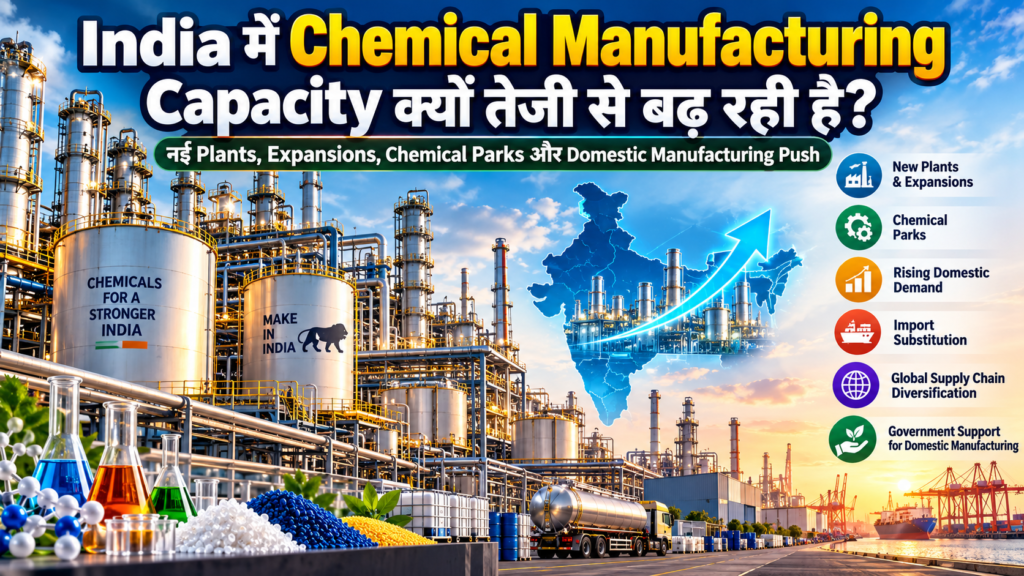
नई Plants, Expansions, Chemical Parks और Domestic Manufacturing Push
India’s chemical industry is entering a new phase of capacity expansion. Across Gujarat, Maharashtra, Andhra Pradesh, Odisha, Tamil Nadu and other industrial clusters, companies are investing in new manufacturing plants, expanding existing facilities and moving into higher-value specialty chemicals and downstream products.
This expansion is not being driven by a single factor. It is the result of rising domestic demand, import substitution, global supply-chain diversification, specialty-chemical opportunities, integrated chemical clusters, infrastructure development and government support for domestic manufacturing.
The scale of the change is visible in the numbers. Installed capacity of selected major chemicals increased from 16.54 million tonnes in FY2022–23 to 17.65 million tonnes in FY2024–25, an increase of about 6.7%. Production of these selected chemicals also increased from 13.04 million tonnes to 13.98 million tonnes over the same period.
So, why are Indian chemical manufacturers adding capacity now?
1. Rising Domestic Demand Is Creating the First Major Driver
Chemical products are used across almost every major manufacturing sector.
These include:
- Pharmaceuticals
- Agrochemicals
- Textiles
- Paints and coatings
- Plastics
- Automotive
- Construction
- Electronics
- Personal care
- Food processing
- Packaging
- Renewable energy
- Batteries and energy storage
As India’s manufacturing base expands, demand for chemical raw materials and intermediates also increases.
The chemical industry therefore benefits not only from chemical-sector growth itself but also from growth in its downstream industries.
According to the Economic Survey 2025–26, the chemicals and petrochemicals sector contributed 8.1% of manufacturing GVA in FY2024.
This creates a strong reason for companies to expand production capacity closer to their customers.
2. Import Substitution Is Becoming More Important
India still imports significant quantities of chemicals and chemical intermediates.
For manufacturers, this creates an opportunity:
If a product is being imported in large quantities and can be manufactured competitively in India, domestic production can become commercially attractive.
This is particularly relevant for:
- Specialty chemicals
- Pharmaceutical intermediates
- Agrochemical intermediates
- Electronic chemicals
- Performance chemicals
- Advanced materials
- High-value downstream petrochemicals
Government policy is explicitly targeting stronger domestic manufacturing and reduced import dependence.
The newly approved BHAVYA Rasayan Scheme is designed specifically to increase domestic chemical production capacity, reduce import dependence and improve India’s competitiveness in global chemical value chains.
3. The New Chemical Parks Could Change the Manufacturing Landscape
One of the most important developments in 2026 is India’s move toward dedicated Chemical Parks.
Under the Bharat Audyogik Vikas Yojana Rasayan (BHAVYA Rasayan) Scheme, the government has approved the establishment of three dedicated Chemical Parks.
The scheme has a total financial outlay of approximately:
₹3,030 crore
This includes:
- ₹3,000 crore for common infrastructure
- ₹30 crore for administrative expenditure
- Up to ₹1,000 crore central grant per park
- Minimum ₹500 crore contribution from the concerned State Government
The scheme is planned for FY2026–27 to FY2030–31.
What will these parks provide?
The proposed parks are designed around a plug-and-play manufacturing model, including:
- Common Effluent Treatment Plants
- Hazardous-waste facilities
- Water infrastructure
- Solvent recovery
- Distillation facilities
- Steam distribution
- Interconnected pipelines
- Logistics
- Warehousing
- Common utilities
This can reduce the infrastructure burden on individual chemical manufacturers.
The Department of Chemicals and Petrochemicals has requested State Governments to submit proposals under the scheme by 30 November 2026.
4. Gujarat Shows What a Chemical Cluster Can Achieve
Gujarat is already one of India’s most important chemical manufacturing hubs.
The Dahej PCPIR is a major example of how integrated infrastructure can attract large-scale chemical investment.
According to the Department of Chemicals and Petrochemicals, India’s three operational PCPIRs — Dahej in Gujarat, Visakhapatnam–Kakinada in Andhra Pradesh and Paradeep in Odisha — have collectively attracted approximately ₹3.4 lakh crore of investment, generated around 3.7 lakh jobs and facilitated more than 2,200 chemical manufacturing units.
For Gujarat specifically, industry data cited by IBEF puts cumulative investment in the Dahej PCPIR at approximately ₹1.29 lakh crore, with more than 2.45 lakh jobs and around 2,079 chemical units.
This demonstrates an important point:
Chemical manufacturing increasingly grows around ecosystems rather than isolated factories.
When raw materials, utilities, ports, logistics, suppliers, waste treatment and downstream customers are located close together, the economics of manufacturing can improve.
5. Companies Are Moving Beyond Basic Chemicals
Another important change is the movement from commodity chemicals toward higher-value specialty and downstream products.
Instead of only producing basic raw materials, manufacturers are increasingly looking at:
- Specialty intermediates
- High-purity chemicals
- Advanced intermediates
- Performance chemicals
- Pharmaceutical intermediates
- Agrochemical intermediates
- Electronic chemicals
- Custom manufacturing
- Contract manufacturing
This can provide manufacturers with more diversified product portfolios and closer relationships with downstream customers.
A recent example is Aarti Industries’ Zone IV project at Jhagadia, Gujarat. In September 2026, the company announced commissioning of Phase I involving calcium chloride, PEDA and part of a multipurpose plant. The company said several products planned from the platform are expected to be manufactured in India for the first time.
This illustrates the broader trend: new capacity is increasingly being designed for downstream integration and specialty applications, not simply additional commodity volume.
6. Existing Plants Are Also Being Expanded
India’s chemical-capacity story is not only about greenfield plants.
Existing manufacturers are also:
- Adding production lines
- Expanding reactors
- Increasing batch sizes
- Building multipurpose plants
- Adding downstream units
- Increasing solvent-recovery capacity
- Improving utilities
- Expanding warehouse capacity
- Adding R&D and pilot facilities
Multipurpose plants are particularly important for specialty chemicals because they allow manufacturers to produce different molecules using shared infrastructure.
This gives companies greater flexibility to respond to changing customer requirements.
7. Petrochemical Companies Are Moving Further Downstream
India’s large refining and petrochemical companies are also increasing downstream manufacturing.
A current example is Indian Oil’s Gujarat refinery at Koyali, which is preparing to commission a 500,000-tonne-per-year polypropylene facility by the end of FY2026–27. The broader refinery expansion is intended to increase crude-processing capacity while increasing the share of petrochemical and specialty products.
This is important because the value chain increasingly looks like:
Crude Oil → Refining → Petrochemicals → Polymers → Specialty Chemicals → Finished Products
Moving further downstream can create additional domestic manufacturing opportunities.
8. China+1 Is Supporting New Investment
Global companies continue to evaluate supply-chain diversification.
The objective is not necessarily to completely replace China. Instead, many companies are looking for:
- Multiple qualified suppliers
- Geographic diversification
- Reliable backup production
- Lower supply-chain concentration
- Long-term manufacturing partnerships
- Specialty chemical suppliers
- Contract manufacturing partners
India’s established chemical clusters, skilled workforce and growing domestic market make it an important candidate for this diversification.
However, the opportunity comes with competition. ICRA notes that global chemical overcapacity and aggressive competition from Chinese suppliers continue to constrain pricing recovery even as Indian specialty chemicals benefit from domestic demand and capacity expansion.
Therefore, capacity expansion alone does not guarantee profitability.
9. Domestic Manufacturing Is Becoming More Strategic
The concept of domestic manufacturing has moved beyond simply “making products in India.”
For chemical companies, it increasingly means building a complete ecosystem:
Raw Materials → Intermediates → Specialty Chemicals → Formulation/Processing → Finished Products
This can reduce:
- Import dependency
- Lead times
- Logistics costs
- Supply disruptions
- Inventory requirements
It can also improve supply visibility for downstream industries.
10. Government Infrastructure Is Supporting the Expansion
Government policy is increasingly focused on creating infrastructure that chemical manufacturers cannot efficiently build individually.
The BHAVYA Rasayan model is important because shared infrastructure can include:
Environmental infrastructure
- CETP
- Hazardous-waste treatment
- TSDF
- Waste-management systems
Utility infrastructure
- Water
- Steam
- Power-related infrastructure
- Common pipelines
Manufacturing support
- Solvent recovery
- Distillation
- Warehousing
- Logistics
This can potentially make industrial locations more attractive to both domestic and international investors.
11. Sustainability Is Becoming Part of Capacity Planning
Chemical manufacturing expansion today cannot be evaluated only on production volume.
Manufacturers increasingly need to consider:
- Energy efficiency
- Water consumption
- Waste reduction
- Solvent recovery
- Emission control
- Hazardous-waste management
- Process safety
- Environmental compliance
- Circular-economy practices
The new Chemical Park framework specifically includes centralized environmental infrastructure, including common effluent treatment and hazardous-waste management.
This can be particularly valuable for smaller and mid-sized manufacturers that may find standalone environmental infrastructure expensive.
12. Specialty Chemicals Are Creating New Capacity Opportunities
India’s specialty chemical sector is experiencing capacity additions across several segments.
Manufacturers are investing in products serving:
Pharmaceuticals
- APIs
- Intermediates
- Building blocks
- High-purity solvents
Agrochemicals
- Herbicide intermediates
- Insecticide intermediates
- Fungicide intermediates
Electronics
- High-purity chemicals
- Semiconductor-related materials
- Electronic-grade solvents
Automotive
- Coatings
- Adhesives
- Performance additives
- Battery-related chemicals
Construction
- Additives
- Coatings
- Sealants
- Performance materials
Consumer products
- Surfactants
- Personal-care ingredients
- Home-care chemicals
This diversification creates opportunities for manufacturers to move into higher-value products.
13. Production Capacity Has Already Been Increasing
The expansion is not merely a future proposal.
Government data shows that production of selected major chemicals increased from:
13.04 million MT in FY2022–23
to
13.98 million MT in FY2024–25.
That’s an increase of approximately 7.2% over two years.
Installed capacity increased from:
16.54 million MT → 17.65 million MT
over the same period.
These figures cover selected major chemicals monitored by the Department of Chemicals and Petrochemicals, rather than every chemical manufactured in India.
14. Chemical Manufacturing Is Becoming More Integrated
The next generation of Indian chemical plants is increasingly being designed around integration.
For example:
Feedstock → Basic Chemical → Intermediate → Specialty Chemical → Downstream Product
Integration can provide advantages in:
- Raw-material security
- Production planning
- Quality control
- Logistics
- Cost management
- Customer responsiveness
This is particularly relevant for large chemical groups with multiple manufacturing sites.
15. Why Gujarat Remains Important
For chemical traders and manufacturers, Gujarat remains one of the most important states to watch.
Major clusters include:
- Dahej
- Bharuch
- Ankleshwar
- Vapi
- Vadodara
- Ahmedabad
- Vatva
- Jhagadia
- Dahej PCPIR
The state combines:
- Ports
- Petrochemical infrastructure
- Industrial estates
- Chemical manufacturers
- Logistics networks
- Skilled workforce
- Large downstream customer base
This ecosystem is one reason Gujarat continues to attract chemical manufacturing investment.
16. What This Means for Chemical Traders
The capacity expansion also creates opportunities for chemical traders and distributors.
As the number of manufacturing plants increases, demand can rise for:
- Raw materials
- Solvents
- Acids
- Bases
- Intermediates
- Specialty chemicals
- Packaging materials
- Industrial chemicals
- Imported raw materials
- Process chemicals
A trader can add value through:
Reliable sourcing
Finding multiple manufacturers for the same chemical.
Inventory availability
Maintaining stock for urgent requirements.
Logistics
Arranging drums, tankers, ISO tanks and other transportation.
Documentation
Providing:
- COA
- SDS
- TDS
- GST invoice
- Batch information
- Origin details
Supplier qualification
Checking whether a company is actually:
Manufacturer / Importer / Stockist / Dealer / Trader
rather than relying only on marketplace descriptions.
17. Capacity Expansion Will Also Increase Competition
More manufacturing capacity has both opportunities and challenges.
If supply grows faster than demand, manufacturers can face:
- Price competition
- Lower capacity utilisation
- Margin pressure
- Inventory accumulation
- Export dependence
ICRA’s August 2026 sector update highlights exactly this tension: Indian specialty chemicals are benefiting from domestic demand and capacity expansion, while global overcapacity, Chinese competition, tariffs and geopolitical risks continue to limit broad-based pricing recovery.
Therefore, the next phase of India’s chemical industry is not simply about building more plants.
It is about building competitive plants.
18. What Will Separate Successful Manufacturers From Others?
The manufacturers likely to remain competitive will need more than production capacity.
Important factors include:
1. Product quality
Consistent specifications and batch-to-batch performance.
2. Cost efficiency
Competitive manufacturing costs.
3. Technology
Modern processes, automation and efficient reactors.
4. Environmental compliance
Strong waste-management and emission-control systems.
5. Supply reliability
Customers increasingly want predictable deliveries.
6. Product development
Ability to develop new intermediates and specialty products.
7. Scale-up capability
Moving efficiently from laboratory → pilot → commercial production.
8. Customer qualification
Ability to meet pharma, agrochemical, electronics and other industry requirements.
19. The Bigger Picture: India Is Building Chemical Manufacturing Depth
The most important change is not simply the number of new factories.
India is gradually developing greater depth across the chemical value chain.
The direction is:
Basic chemicals
↓
Intermediates
↓
Specialty chemicals
↓
Advanced materials
↓
Downstream manufacturing
↓
Finished products
At the same time, infrastructure is moving toward integrated clusters with shared utilities, logistics and environmental facilities.
20. What to Watch During 2026–2030
For anyone involved in the Indian chemical market, several indicators will be important.
Watch 1 — Chemical Parks
Implementation of the three BHAVYA Rasayan Chemical Parks.
Watch 2 — New Manufacturing Plants
Greenfield investments in Gujarat, Maharashtra, Odisha, Andhra Pradesh and Tamil Nadu.
Watch 3 — Capacity Utilisation
Whether new capacity translates into actual production.
Watch 4 — Import Substitution
Which chemicals currently imported into India begin to receive domestic manufacturing capacity.
Watch 5 — Specialty Chemicals
Expansion into higher-value products.
Watch 6 — Global Supply Chains
New international customers and manufacturing partnerships.
Watch 7 — Export Growth
Whether Indian manufacturers can absorb new capacity through exports.
Watch 8 — Environmental Infrastructure
Expansion of CETPs, hazardous-waste facilities and solvent-recovery systems.
Conclusion
India’s chemical manufacturing capacity is expanding because demand, infrastructure, investment, policy and supply-chain diversification are moving in the same direction.
The country already has a large chemical manufacturing base, but the next stage is focused increasingly on specialty chemicals, downstream integration, import substitution and globally competitive manufacturing.
Government initiatives such as BHAVYA Rasayan, the development of Chemical Parks and existing PCPIR infrastructure are designed to address some of the infrastructure and integration challenges that can limit chemical-sector investment.
At the company level, recent projects such as Aarti Industries’ Zone IV expansion in Jhagadia and Indian Oil’s planned polypropylene capacity in Gujarat illustrate how Indian manufacturers are adding new capabilities and moving further downstream.
The opportunity, however, is not simply “more capacity.”
The bigger opportunity is:
More competitive, integrated, sustainable and higher-value chemical manufacturing in India.
For manufacturers, this could mean new markets and product opportunities. For chemical traders, it could mean a larger domestic supplier base, more sourcing options and increasing demand for raw materials and intermediates.
The next few years will therefore be important for India’s position in the global chemical value chain.
Quick Snapshot
| Factor | Current Direction |
|---|---|
| Domestic chemical demand | Increasing |
| Installed capacity | Expanding |
| New plants | Increasing |
| Existing plant expansions | Increasing |
| Specialty chemicals | Strong investment interest |
| Import substitution | Major policy objective |
| Chemical Parks | 3 planned under BHAVYA Rasayan |
| BHAVYA Rasayan outlay | ₹3,030 crore |
| Major chemical production | 13.04 → 13.98 million MT, FY23–FY25 |
| Dahej PCPIR | Major Indian chemical cluster |
| Global competition | Remains significant |
| China+1 opportunity | Continuing |
| Environmental infrastructure | Increasing importance |