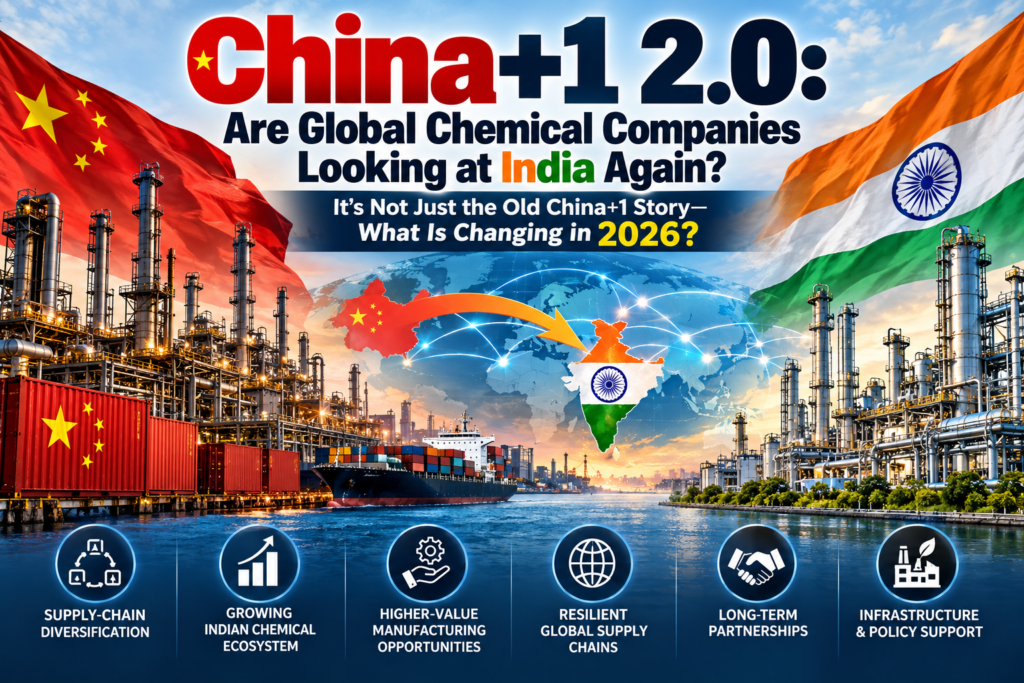
It’s Not Just the Old China+1 Story—What Is Changing in 2026?
For several years, “China+1” has been one of the most discussed themes in global manufacturing. The basic idea was simple: multinational companies that depended heavily on China wanted to add another country to their supply chain to reduce concentration risk.
India was one of the countries that benefited from this shift, particularly in specialty chemicals, pharmaceutical intermediates, agrochemicals, dyes, performance chemicals and contract manufacturing.
But the situation in 2026 is different.
This is no longer simply a story about companies moving production away from China. The emerging “China+1 2.0” model is increasingly about building multiple qualified suppliers, developing higher-value products, establishing long-term manufacturing partnerships, strengthening local infrastructure and creating resilient global supply chains.
At the same time, India faces significant competition from Chinese suppliers, global chemical overcapacity, pricing pressure and geopolitical uncertainty. ICRA noted in August 2026 that Indian specialty chemicals are benefiting from domestic demand and capacity expansion, while global overcapacity and aggressive Chinese competition continue to restrict broad-based price recovery.
So, the important question is not simply:
“Are companies leaving China for India?”
The more relevant question is:
“Is India becoming a more important second manufacturing and sourcing base for the global chemical industry?”
The developments of 2026 suggest that this question deserves serious attention.
1. What Was the Original China+1 Strategy?
The first wave of China+1 accelerated during the COVID-19 period.
Global manufacturers experienced:
- Factory shutdowns
- Shipping disruptions
- Raw-material shortages
- Longer lead times
- Logistics uncertainty
- Dependence on a concentrated supplier base
Chemical companies were particularly sensitive to these problems because many pharmaceutical, agrochemical, electronic and specialty chemical supply chains depend on specific intermediates and raw materials.
As a result, international buyers began asking:
“If we already buy from China, where else can we qualify a second supplier?”
India emerged as one of the important candidates.
Its advantages included:
- Large chemical manufacturing base
- Strong pharmaceutical industry
- Growing specialty chemical sector
- Large engineering and scientific talent pool
- Established industrial clusters
- Export experience
- English-speaking technical and commercial workforce
- Increasing capabilities in custom manufacturing and R&D
But the 2026 version is becoming more sophisticated.
2. China+1 2.0 Is About Supply-Chain Diversification
China+1 2.0 does not necessarily mean:
China → India
Instead, it increasingly means:
China + India + Europe/US + other regional suppliers
A global chemical company may continue buying from China while simultaneously qualifying Indian manufacturers for selected products.
This distinction is important.
Companies are not necessarily replacing one country with another. Instead, they are trying to create resilient multi-source supply chains.
For a chemical buyer, this can mean:
- One supplier in China
- One qualified supplier in India
- Potentially another supplier in Europe or another Asian market
This approach reduces dependence on a single manufacturing location.
For Indian manufacturers, the opportunity therefore lies not only in replacing Chinese production but also in becoming a qualified second or third global source.
3. Why India Is Receiving More Attention in 2026
India’s chemical sector already has a large industrial ecosystem.
Important chemical manufacturing clusters include:
- Gujarat
- Maharashtra
- Tamil Nadu
- Andhra Pradesh
- Telangana
- Odisha
- Karnataka
- Rajasthan
Within Gujarat, clusters such as Dahej, Ankleshwar, Bharuch, Vapi, Vadodara, Ahmedabad and Vatva provide an established ecosystem of manufacturers, suppliers, logistics providers and downstream industries.
The government’s PCPIR programme has also created significant industrial concentration. According to the Department of Chemicals and Petrochemicals, the three operational PCPIRs at Dahej, Visakhapatnam–Kakinada and Paradeep have attracted ₹3.4 lakh crore of investment, generated 3.7 lakh jobs and facilitated more than 2,200 chemical manufacturing units.
That existing ecosystem is important because global customers generally prefer sourcing from regions where:
raw materials + utilities + manufacturing + testing + logistics + skilled manpower + downstream customers
are already available.
4. The Biggest Change: India Wants to Move Up the Value Chain
One of the most important changes in India’s chemical industry is the increasing focus on higher-value chemistry.
The opportunity is no longer limited to producing large volumes of basic chemicals.
The industry is increasingly moving toward:
Specialty Chemicals
Products designed for specific industrial applications.
Pharmaceutical Intermediates
High-value molecules used in API manufacturing.
Agrochemical Intermediates
Building blocks for crop-protection products.
Electronic Chemicals
High-purity materials required for advanced electronics and semiconductor-related applications.
Performance Chemicals
Chemicals designed to deliver specific performance characteristics.
Custom Manufacturing
Production according to a customer’s specific process or specification.
Contract Research and Manufacturing
Combining R&D, process development and commercial production.
This shift is significant because global customers are often looking for technical capability and reliability, not simply the lowest price.
5. Global Chemical Companies Are Showing Interest—But Qualification Takes Time
There is evidence of renewed international interest in India’s chemical manufacturing ecosystem.
In 2026, India’s Department of Chemicals and Petrochemicals, together with Invest India, held a high-level CEO roundtable involving more than 30 leading global and Indian chemical companies.
Participants included companies such as BASF, Tronox, ExxonMobil, Fujifilm, Lubrizol, Dow Chemicals and SABIC, alongside major Indian companies. The discussions focused on investment, infrastructure, R&D, technology, financing, supply-chain resilience and India’s ambition to develop a globally competitive chemicals manufacturing and innovation ecosystem.
However, this should not be interpreted as proof that all these companies are shifting production to India.
A more accurate interpretation is that India is increasingly part of the strategic discussion around global chemical supply chains and future manufacturing investment.
And that distinction matters.
6. Chemical Parks Could Change the Investment Equation
Infrastructure has historically been one of the major factors affecting chemical manufacturing investment.
A chemical company does not need only land.
It needs:
- Power
- Water
- Steam
- Effluent treatment
- Waste management
- Storage
- Fire and safety infrastructure
- Roads
- Logistics
- Testing facilities
- Common utilities
- Environmental infrastructure
In 2026, the Indian government moved forward with the BHAVYA Rasayan Scheme for three dedicated Chemical Parks.
The Union Cabinet approved the scheme in July 2026 with a total financial outlay of ₹3,030 crore, including ₹3,000 crore for common infrastructure and basic utilities. The Centre can provide a grant of up to ₹1,000 crore per park, subject to a minimum state contribution of ₹500 crore.
The Department of Chemicals and Petrochemicals says the scheme is intended to increase domestic production, reduce import dependence and improve export competitiveness. States were invited to submit proposals by 30 November 2026.
This is one of the clearest examples of how China+1 2.0 is becoming an infrastructure story as well as a manufacturing story.
7. The New Chemical Park Model: Plug-and-Play Manufacturing
The proposed model is designed around shared infrastructure.
Instead of every chemical manufacturer having to independently build every utility and facility, chemical parks can potentially provide common infrastructure.
This could help companies with:
- Faster project development
- Shared utilities
- Waste-treatment infrastructure
- Better logistics
- Industrial clustering
- Supplier proximity
- Lower infrastructure duplication
For multinational companies evaluating manufacturing locations, this type of infrastructure can influence the economics of setting up a new facility or partnering with an Indian manufacturer.
8. But China Remains a Major Competitor
It would be incorrect to describe China+1 as a simple story of China losing its chemical manufacturing advantage.
China continues to have enormous chemical production capacity and a highly integrated manufacturing ecosystem.
And in 2026, Chinese competition remains a major issue for Indian companies.
ICRA’s August 2026 assessment specifically identified global overcapacity and aggressive competition from Chinese suppliers as factors limiting broad-based pricing recovery in India’s specialty chemical sector.
This creates a complicated situation.
Indian manufacturers may receive more enquiries from global customers while simultaneously facing:
higher competition + lower pricing power + Chinese capacity + global oversupply.
Therefore, simply having additional capacity is not enough.
9. Why “Low-Cost India” Is No Longer Enough
The first version of China+1 was heavily associated with cost competitiveness.
China+1 2.0 is more demanding.
Global chemical buyers increasingly evaluate suppliers based on:
Product Quality
Can the manufacturer consistently meet the required specification?
Regulatory Compliance
Can the company provide the necessary documentation?
Traceability
Can the customer identify the manufacturing source and batch history?
Supply Reliability
Can the supplier deliver consistently?
Technical Support
Can the manufacturer solve process and quality problems?
Scalability
Can production increase when demand grows?
Environmental Compliance
Can the company meet increasingly demanding environmental requirements?
Commercial Stability
Can the supplier remain competitive over a multi-year relationship?
The lowest quoted price may therefore not be enough to win a global contract.
10. Documentation Is Becoming a Competitive Advantage
For chemical traders and manufacturers, documentation is becoming increasingly important.
International customers may ask for:
- COA
- SDS
- TDS
- Product specification
- Manufacturing location
- Batch information
- Country of origin
- Regulatory declarations
- REACH-related information where applicable
- Traceability information
- Environmental documentation
- Quality certifications
- Audit documentation
For a chemical supplier, this means that quality documentation can become part of the product itself.
A supplier that can provide a consistent product with complete documentation may have an advantage over an otherwise similar supplier that cannot.
11. Technology Is Becoming Another Part of China+1 2.0
The next stage of Indian chemical manufacturing will not depend only on adding reactors.
Manufacturers are increasingly looking at:
- Process optimisation
- Automation
- Continuous manufacturing
- Process safety
- Energy efficiency
- Waste reduction
- Advanced analytical testing
- Digital production monitoring
- Process development
- Scale-up capabilities
- R&D
This is particularly important for specialty chemicals and pharmaceutical intermediates.
A global customer may initially approach an Indian company for a relatively small-volume molecule.
If the Indian manufacturer can successfully develop the process, qualify the product and scale production, that relationship can potentially develop into a much larger long-term manufacturing partnership.
12. Contract Manufacturing Could Be One of the Biggest Opportunities
China+1 2.0 is creating opportunities beyond traditional merchant manufacturing.
Global companies may not always want to build their own factory.
Instead, they can work with an Indian manufacturer through:
- Contract manufacturing
- Custom synthesis
- Toll manufacturing
- CDMO arrangements
- Joint development
- Technology partnerships
This model can be particularly attractive for specialty chemicals and intermediates.
The Indian company provides manufacturing and technical capabilities while the global customer provides specifications, demand visibility and sometimes technical know-how or process requirements.
13. India’s Domestic Market Is Also Becoming Important
Another major difference between today’s India opportunity and the original China+1 narrative is India’s own consumption.
India is not only an export manufacturing location.
Chemical demand is connected to:
- Pharmaceuticals
- Agriculture
- Construction
- Automotive
- Textiles
- Packaging
- Electronics
- Renewable energy
- Consumer products
- Infrastructure
- Paints and coatings
Government officials noted in a 2026 chemicals-sector roundtable that India’s chemical demand is growing strongly, with demand linked to areas including EVs, semiconductors, renewable energy and textiles.
This gives manufacturers a potential dual market:
Domestic demand + export demand
That can make investment decisions more attractive than relying exclusively on exports.
14. India’s Export Momentum Is Also Visible
India’s chemical export performance remains an important part of the story.
Government trade data showed that India’s organic and inorganic chemical exports increased 16.38% year-on-year in August 2026, from US$2.41 billion in August 2025 to US$2.80 billion in August 2026.
This does not mean every chemical category is growing at the same rate.
But it demonstrates that chemicals remain an important component of India’s international trade.
For Indian manufacturers, the next challenge is to convert export growth into long-term customer relationships and higher-value products, rather than competing only on spot prices.
15. What Does China+1 2.0 Mean for Indian Chemical Manufacturers?
For Indian manufacturers, the opportunity can be divided into several areas.
1. Become a Qualified Second Source
Global customers need reliable alternatives.
Manufacturers that can pass technical and quality qualification processes may become second-source suppliers.
2. Move Toward Specialty Products
Commodity chemicals can face intense price competition.
Specialty molecules can provide opportunities for differentiation.
3. Invest in R&D
Process development can become a competitive advantage.
4. Improve Quality Systems
Consistent quality is essential for global customers.
5. Build Export Capability
Manufacturers need knowledge of international documentation, logistics and regulatory requirements.
6. Build Long-Term Customer Relationships
The objective should increasingly be recurring business rather than one-time spot transactions.
16. What Does It Mean for Chemical Traders?
China+1 2.0 is not only a manufacturer story.
It also creates opportunities for chemical traders, distributors and sourcing companies.
International and domestic buyers increasingly need suppliers who can quickly identify:
- Alternative manufacturers
- Indian sources
- Imported material
- Domestic stock
- Different grades
- Different packing
- Backup suppliers
- Competitive landed costs
For a chemical trading company, having a reliable supplier database can therefore become a major business asset.
A trader who knows:
CAS Number → Manufacturer → Location → Capacity → Purity → Packing → MOQ → Contact → COA → Availability
can respond to customer enquiries much faster.
17. Gujarat Could Remain at the Centre of This Opportunity
Gujarat has several advantages in the China+1 discussion.
The state has established chemical clusters around:
- Ahmedabad
- Vadodara
- Ankleshwar
- Bharuch
- Dahej
- Vapi
- Jhagadia
- Sanand
- Vatva
- Kutch
Dahej is particularly important because it is one of India’s operational PCPIR locations.
The combination of:
chemical manufacturing + ports + petrochemicals + downstream industries + logistics + skilled manpower
creates an ecosystem that can support both domestic and international chemical supply chains.
18. What Could Stop India From Capturing the Opportunity?
China+1 2.0 is not guaranteed to benefit India automatically.
Several challenges remain.
Global Overcapacity
If global supply exceeds demand, prices can remain under pressure.
Chinese Competition
Chinese manufacturers continue to compete aggressively across multiple chemical categories.
Infrastructure
Chemical manufacturing requires specialised infrastructure.
Environmental Compliance
Chemical companies must manage increasingly demanding environmental and safety requirements.
Financing
Large chemical projects require significant capital.
Technology
Some advanced products require specialised technologies and R&D capabilities.
Qualification Time
A multinational customer may take considerable time to qualify a new chemical supplier.
Raw Materials
Dependence on imported feedstocks can reduce the benefit of local manufacturing.
19. China+1 2.0 Is Really About “China + India + Resilience”
The most important conceptual change is this:
Old China+1
“We need an alternative to China.”
China+1 2.0
“We need a resilient global supply chain with multiple qualified sources.”
India can become one of those important sources.
But becoming a global manufacturing partner requires more than cheap labour or available land.
It requires:
Quality + Technology + Infrastructure + Compliance + Reliability + Scale + Competitive Cost
20. What Should Chemical Companies Watch in 2026–27?
Anyone involved in India’s chemical industry should monitor several indicators.
Chemical Park Development
Which states are selected under the BHAVYA Rasayan Scheme and how quickly infrastructure develops.
New Manufacturing Capacity
Track new plants, production blocks and capacity expansions.
Global Customer Qualification
Watch whether Indian manufacturers are securing long-term contracts and second-source approvals.
Specialty Chemical Demand
Monitor pharmaceuticals, agrochemicals, electronics, semiconductors, EVs and renewable-energy-related chemicals.
Chinese Pricing
Chinese oversupply and pricing can significantly affect Indian manufacturers.
Import Substitution
Identify products that India continues to import in significant quantities but can potentially manufacture competitively.
Export Growth
Track whether export growth continues across organic, inorganic and specialty chemical categories.
Technology Investment
Watch investments in R&D, automation, continuous processing and advanced manufacturing.
21. The Biggest Opportunity May Be Import Substitution
One of the most interesting opportunities for Indian chemical companies is identifying products that are:
highly imported + technically feasible to manufacture in India + sufficiently valuable + supported by domestic demand.
This can create opportunities for:
- Existing manufacturers
- New chemical projects
- Contract manufacturers
- Specialty chemical companies
- Chemical traders
- R&D companies
The government itself describes the BHAVYA Rasayan scheme as a measure intended to strengthen domestic production, reduce import dependence and enhance export competitiveness.
For entrepreneurs, this creates an important research question:
Which chemicals are still heavily dependent on imports, and can India manufacture them competitively?
That question could generate the next generation of chemical manufacturing opportunities.
22. Final Outlook: Is China+1 2.0 Real?
The evidence in 2026 points toward greater international attention to India as part of diversified chemical supply chains, but it would be too simplistic to describe the trend as a mass migration from China to India.
The more accurate picture is a gradual transformation.
Global companies are looking for:
- Multiple suppliers
- Supply-chain resilience
- Reliable manufacturing partners
- Higher-value chemistry
- Competitive production
- Technical capabilities
- Regulatory compliance
- Long-term supply security
India has many of the building blocks required for this transition.
At the same time, Indian companies must deal with Chinese competition, global overcapacity, pricing pressure, infrastructure requirements and technology gaps.
The 2026 developments around dedicated Chemical Parks, international industry discussions, domestic capacity expansion and continued export activity suggest that India’s role in the global chemical supply chain is evolving.
The real China+1 2.0 opportunity is therefore not simply:
“Move production from China to India.”
It is:
“Build India into a reliable, globally connected, technologically capable and diversified chemical manufacturing base.”
And for Indian chemical manufacturers, suppliers and traders, that could make the next few years particularly important.
China+1 2.0 — Quick Snapshot
| Factor | Earlier China+1 | China+1 2.0 |
|---|---|---|
| Main objective | Reduce China dependence | Build resilient multi-source supply chains |
| Indian opportunity | Low-cost manufacturing | Manufacturing + R&D + specialty chemicals |
| Products | Commodity & intermediates | Specialty, advanced & high-purity products |
| Customer relationship | Spot/short-term | Qualification & long-term partnerships |
| Infrastructure | Individual facilities | Integrated chemical parks |
| Technology | Production capacity | Process technology + automation + R&D |
| Documentation | Basic commercial documents | Quality, regulatory & traceability systems |
| Competition | China | China + global suppliers |
| Major opportunity | Alternative sourcing | Strategic global manufacturing partnerships |
| Key Indian advantage | Cost + manufacturing base | Ecosystem + scale + technical capabilities |