
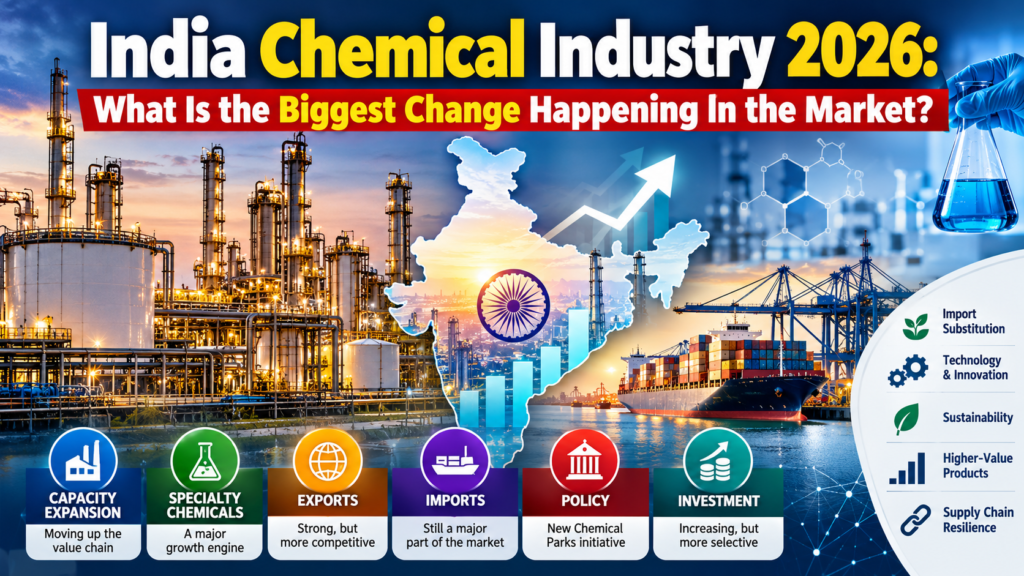
India’s chemical industry is entering a new phase in 2026. The story is no longer only about adding production capacity. The bigger shift is toward domestic manufacturing, specialty chemicals, import substitution, integrated chemical parks, higher-value products and supply-chain resilience.
At the same time, Indian manufacturers are dealing with global overcapacity, strong Chinese competition, tariff uncertainty and pressure on pricing.
For chemical manufacturers, importers, traders and buyers, this is creating both opportunities and new challenges.
India Chemical Industry 2026: The Big Picture
India is already one of the world’s major chemical producers and ranks sixth globally in chemical production, according to the Government of India. Major chemical manufacturing clusters include Gujarat, Odisha, Andhra Pradesh and Tamil Nadu.
The domestic market is also expanding rapidly. Government data shows India’s petrochemical demand increased from about 9 million tonnes in 2007 to 40 million tonnes in 2024, while production increased from 8.6 million tonnes to 28 million tonnes.
The next phase is therefore about closing the gap between what India consumes and what India produces.
1. Capacity Expansion Is Moving Up the Value Chain
India continues to add chemical and petrochemical capacity, but the focus is increasingly shifting toward specialty chemicals and higher-value intermediates.
Government projections for 2026–27 show continued expansion across major chemical groups. For example, projected alkali-chemical capacity rises to about 12.47 million tonnes, while inorganic chemical capacity is projected at about 1.70 million tonnes.
This matters because capacity expansion is no longer simply about producing more bulk chemicals.
Companies are increasingly looking at:
- Specialty chemicals
- Pharmaceutical intermediates
- Agrochemical intermediates
- Electronic chemicals
- High-purity chemicals
- Performance chemicals
- Sustainable chemistry
- Advanced materials
The commercial opportunity is moving toward products where technology, quality and reliability matter as much as price.
2. Specialty Chemicals Are Becoming a Major Growth Engine
Specialty chemicals are one of the most important areas to watch.
India’s specialty chemicals market was estimated at approximately US$67 billion in 2025, with projections reaching about US$93.4 billion by 2034, according to IBEF. Demand is supported by pharmaceuticals, agriculture, automotive, construction, electronics and industrial applications.
The opportunity is particularly relevant for companies producing:
- Pharma intermediates
- Agrochemical intermediates
- Dyes and dye intermediates
- Coating chemicals
- Adhesives
- Surfactants
- Performance additives
- High-purity solvents
- Electronic chemicals
This is also where smaller Indian manufacturers can potentially compete by focusing on custom synthesis, smaller production batches and specialized products.
3. Exports Remain Important — But the Market Is More Competitive
India remains an important global chemical exporter.
In FY2025–26:
- Organic chemical exports: ₹67,871 crore
- Inorganic chemical exports: ₹21,286 crore
- Agrochemical exports: ₹34,211 crore
- Dyes: ₹19,352 crore
- Dye intermediates: ₹1,641 crore
These figures show that India’s chemical export base is already broad.
However, export growth is not automatically translating into higher margins.
ICRA’s 2026 sector assessment points to global overcapacity, aggressive Chinese competition, tariff uncertainty and geopolitical risks as factors limiting broad-based pricing recovery in specialty chemicals.
For Indian exporters, therefore, the competitive equation is changing:
Price + Quality + Delivery + Compliance + Technical Support
rather than price alone.
4. Imports Are Still a Major Part of India’s Chemical Market
India’s chemical industry continues to rely heavily on imported raw materials and intermediates.
In FY2025–26:
- Organic chemical imports: ₹1,33,254 crore
- Inorganic chemical imports: ₹64,339 crore
- Agrochemical imports: ₹13,556 crore
- Dye intermediate imports: ₹13,471 crore
This creates an important opportunity for Indian manufacturers.
Products that are currently imported in significant quantities can potentially become targets for domestic capacity creation and import substitution.
For chemical traders, it also creates another opportunity: importing specialized products and building reliable domestic distribution networks.
5. The Biggest Policy Change: Dedicated Chemical Parks
One of the most significant developments in 2026 is the Government’s new Chemical Parks initiative.
The Union Budget 2026–27 allocated ₹600 crore to support three dedicated Chemical Parks through a challenge-based mechanism. The proposed parks are intended to use a cluster-based, plug-and-play model with shared infrastructure and environmental facilities.
The objective is straightforward:
Make it easier and faster to establish chemical manufacturing facilities in India.
Shared infrastructure can potentially reduce:
- Project development costs
- Infrastructure duplication
- Environmental compliance costs
- Utility costs
- Project implementation timelines
For MSME chemical manufacturers, this could become particularly important.
6. Gujarat Remains a Critical Chemical Manufacturing Hub
For anyone involved in India’s chemical trade, Gujarat remains one of the most important regions to watch.
Major chemical clusters include:
- Ahmedabad
- Vadodara
- Ankleshwar
- Bharuch
- Dahej
- Vapi
- Jhagadia
- Sanand
- Vatva
- Kutch
Government policy documents continue to identify Gujarat as one of India’s established chemical and petrochemical investment hubs.
The Gujarat ecosystem provides access to:
Manufacturers → Raw materials → Ports → Logistics → Pharma → Agrochemicals → Specialty chemicals → Export markets
This integrated ecosystem is one of India’s major competitive advantages.
7. Investment Is Increasing, but Investors Are Becoming More Selective
Chemical investment in India is increasingly focused on strategic capacity rather than capacity for its own sake.
Companies are looking at areas such as:
- Specialty chemicals
- Pharma intermediates
- Electronic chemicals
- Battery materials
- Advanced materials
- Sustainable chemicals
- High-performance polymers
- Import-substitution products
The government has also introduced measures aimed at strengthening domestic manufacturing infrastructure.
For example, the Bulk Drug Parks scheme is supporting parks in Gujarat, Andhra Pradesh and Himachal Pradesh, with central assistance of ₹1,000 crore for each approved park.
8. The Chemical Industry Is Becoming More Technology-Driven
Another major change is the increasing importance of technology.
Traditional chemical manufacturing competed primarily on:
Cost + Capacity
The emerging model is:
Technology + Quality + Scale + Compliance + Customer Integration
Manufacturers are investing more in:
- Process optimization
- Automation
- Continuous manufacturing
- Process safety
- Waste reduction
- Energy efficiency
- Analytical testing
- R&D
- Custom synthesis
This is particularly important in pharmaceutical and specialty chemical intermediates.
9. Sustainability Is Becoming a Commercial Requirement
Environmental compliance is increasingly becoming part of international chemical trade.
Global customers are asking Indian suppliers for:
- SDS
- COA
- Traceability
- Manufacturing information
- Environmental documentation
- Product consistency
- Regulatory compliance
- Responsible waste management
For exporters, sustainability is therefore becoming more than an environmental issue.
It is becoming part of market access.
The 2026 policy environment also places greater emphasis on environmental infrastructure and integrated manufacturing clusters.
10. What Does This Mean for Chemical Traders?
For chemical traders and distributors, 2026 presents a different business environment.
Customers increasingly want:
Reliable supply
They don’t want to change suppliers every time there is a shortage.
Consistent quality
A low-price chemical with inconsistent specifications can become expensive for the end user.
Faster delivery
Regional stock points can become a competitive advantage.
Documentation
Buyers increasingly expect:
- COA
- SDS
- GST invoice
- Batch information
- Manufacturer details
- Origin information
Competitive landed pricing
Customers increasingly compare:
Product price + GST + freight + packaging + delivery time
rather than simply comparing the quoted ₹/kg.
11. Import Substitution Could Become One of the Biggest Opportunities
India’s large chemical import bill shows that significant opportunities remain.
The opportunity can be divided into three categories:
Bulk chemicals
Large-volume products where scale and logistics are critical.
Intermediates
Products used by pharmaceutical, agrochemical and specialty chemical manufacturers.
Specialty chemicals
Lower-volume but higher-value products where technical capability and customer qualification matter.
For smaller chemical businesses, specialty intermediates and niche products may offer a more practical entry point than competing directly in large commodity chemicals.
12. What Should Chemical Companies Watch in 2026?
For the rest of 2026, the major factors to monitor are:
1. Chinese chemical capacity and pricing
China’s excess capacity can influence global chemical prices.
2. Import trends
Rising imports can indicate either strong domestic demand or insufficient domestic capacity.
3. New Indian manufacturing capacity
New plants can change the domestic supply-demand balance.
4. Chemical Park implementation
The execution of the new Chemical Parks programme will be important for future manufacturing investment.
5. Specialty chemical demand
Pharma, agrochemicals, electronics, automotive and infrastructure remain important end-use sectors.
6. Export markets
Tariffs, geopolitics and global demand can influence Indian exporters.
7. Environmental regulations
Compliance costs and customer requirements will continue to influence competitiveness.
The Biggest Change in India’s Chemical Industry
The biggest structural change is not simply “India is producing more chemicals.”
It is that India is trying to move from being primarily a large chemical consumer and exporter of selected products toward becoming a more integrated, higher-value and strategically self-reliant chemical manufacturing base.
The policy push for dedicated Chemical Parks, continued specialty-chemical investment, import-substitution opportunities and expansion of domestic manufacturing infrastructure all point in that direction.
But the transition will not be automatic.
Indian companies still face global overcapacity, Chinese competition, tariff uncertainty, raw-material volatility and the need for stronger technology and infrastructure.
For manufacturers, traders and investors, the key question for 2026 is therefore not simply:
“How much chemical capacity will India add?”
It is:
“Which chemicals will India manufacture competitively, which will remain import-dependent, and which specialty products can Indian companies capture in global markets?”
That is likely to define the next phase of India’s chemical industry.
2026 Chemical Industry Snapshot
| Area | 2026 picture |
|---|---|
| Domestic demand | Strong structural growth |
| Specialty chemicals | Major growth opportunity |
| Imports | Still substantial |
| Exports | Strong, but competitive |
| Manufacturing | Capacity expansion continuing |
| Chemical parks | New ₹600 crore central-support scheme |
| Gujarat | Major manufacturing hub |
| Import substitution | Significant opportunity |
| Technology | Increasingly important |
| Sustainability | Increasingly important |
| Global competition | High |
| Pricing environment | Competitive |