
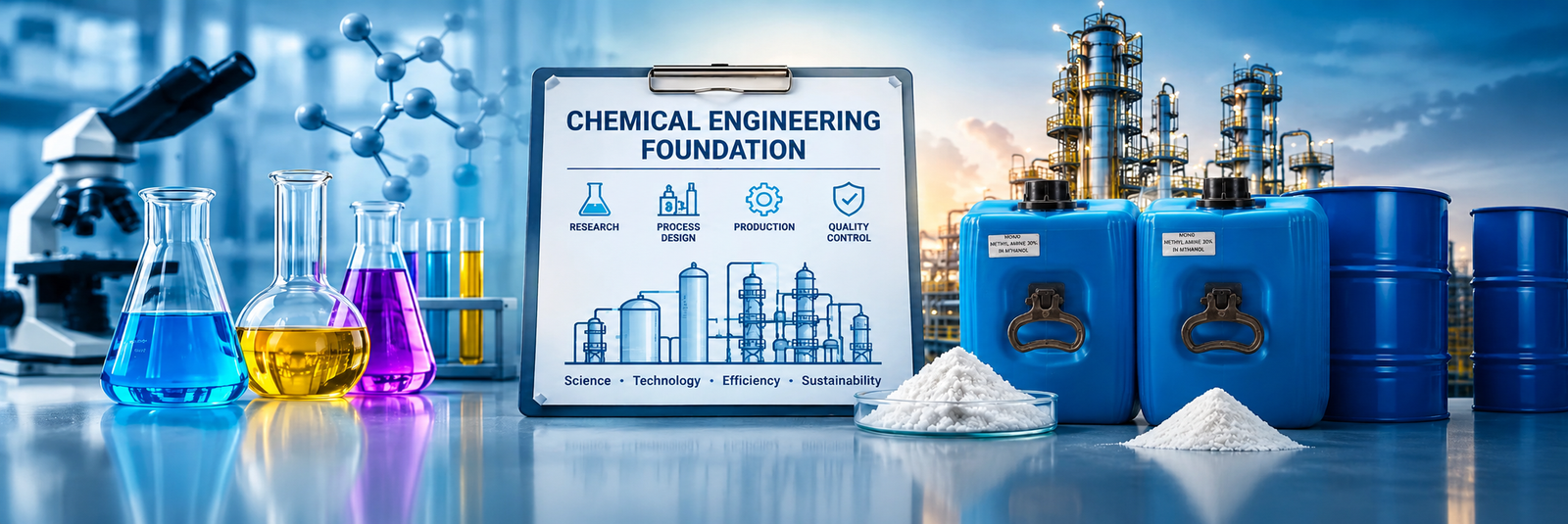
Chemical engineering is where chemistry, technology, and business come together. Behind every solvent, pharmaceutical intermediate, API, or specialty chemical is a carefully controlled process where temperature, reaction time, purity, and efficiency play an important role.
Understanding these fundamentals helps chemical businesses make better decisions about production, sourcing, quality, and cost.
Why Do Chemical Reactions Happen?
For a chemical reaction to occur, molecules need sufficient energy to overcome the activation energy barrier. Temperature can increase reaction rates, while catalysts can provide an alternative pathway with lower activation energy.
In industrial manufacturing, the objective is not simply to make a reaction faster. The process must achieve the right balance between reaction rate, product quality, safety, and operating cost.
Yield, Conversion & Selectivity
Three important measures determine the efficiency of a chemical process:
• Conversion – how much of the starting material reacts.
• Selectivity – how much of the reaction produces the desired product instead of unwanted by-products.
• Yield – how effectively the overall process produces the required product.
High conversion with poor selectivity can increase waste and purification costs. Therefore, successful chemical manufacturing requires optimization of all three.
Why Temperature Control Matters
Temperature directly influences reaction rate, product quality, pressure, and safety. Exothermic reactions release heat, while endothermic reactions require heat input.
Poor temperature control can result in unwanted reactions or, in extreme cases, a runaway reaction. Reliable heating, cooling, and process-control systems are therefore essential in chemical manufacturing.
Batch vs Continuous Manufacturing
Batch manufacturing provides greater flexibility and is commonly suitable for specialty chemicals, pharmaceutical intermediates, and products requiring frequent changes.
Continuous manufacturing is generally more suitable for high-volume production where consistent operating conditions and high throughput are priorities.
The right choice depends on production volume, product characteristics, investment, flexibility, and process requirements.
The Science Behind Distillation
Distillation separates components based primarily on differences in volatility and boiling point. It is widely used for solvent purification and recovery.
Purity requirements, reflux ratio, and energy consumption must be carefully balanced. Higher separation efficiency can require greater energy input, making process optimization important for controlling production costs.
Chemistry That Creates Business Value
Chemical engineering is ultimately about efficiency, consistency, safety, and economics. From raw-material quality to reaction performance and final purification, every stage can influence the cost and quality of the finished product.
At Crystal ChemiTrade, we understand the importance of these factors in chemical procurement. With a broad portfolio of solvents, KSMs, APIs, pharma intermediates, acids, amines, specialty chemicals, and laboratory chemicals, we focus on dependable sourcing, quality-focused service, and reliable supply to support diverse industrial requirements.
Understanding the chemistry behind the process is the first step toward making better chemical business decisions.